10 July 2026 · 2 min read
The 450-Million-Year-Old Volcano That Holds the Great Barrier Reef
The Great Barrier Reef grows on the eroded stumps of a 450-million-year-old volcanic arc that forms its hidden foundation.
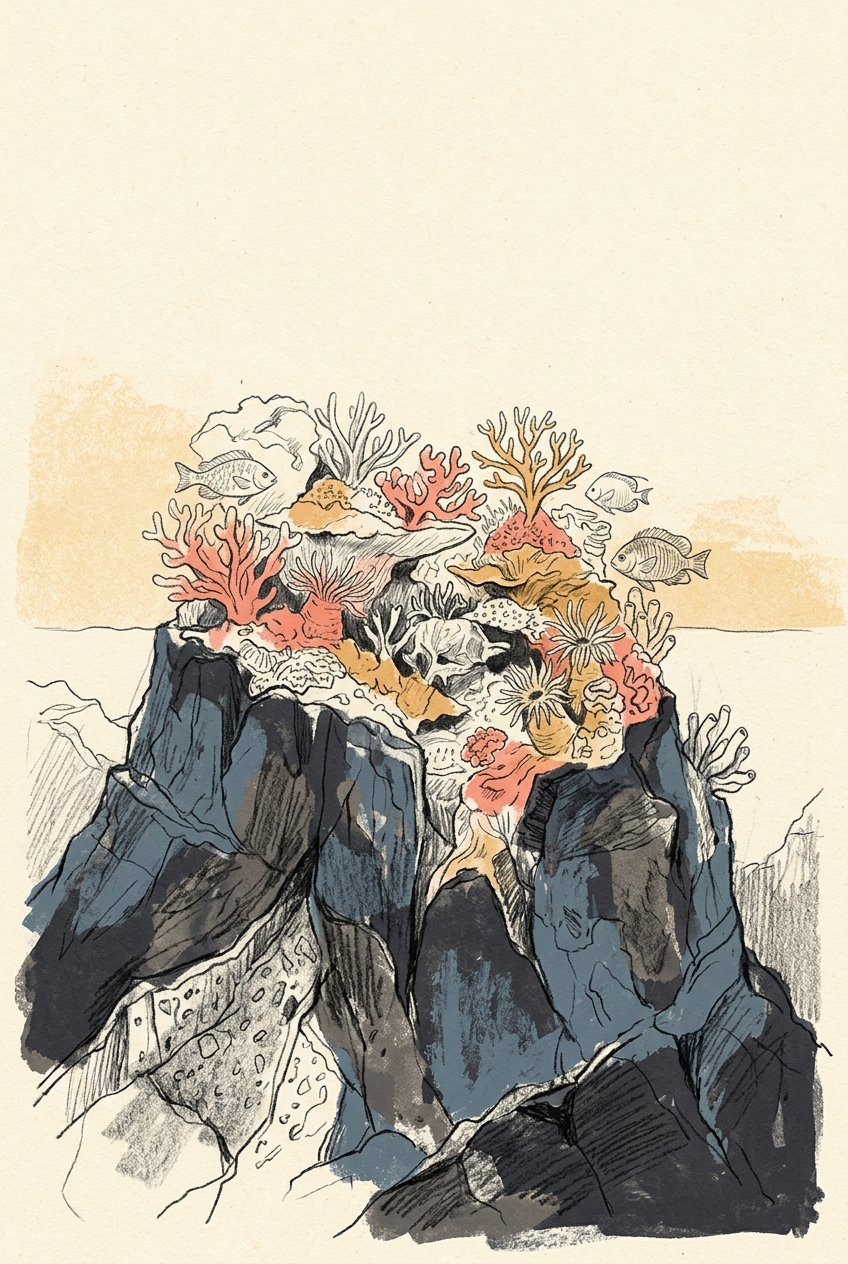
The 450-million-year-old volcanic island chain that built the Great Barrier Reef still stands beneath it—a skeleton of rhyolite and granite that the modern reef merely veneered.
The Siluro-Devonian Arc
Four hundred and fifty million years ago, during the Silurian Period, a chain of volcanoes erupted along the eastern edge of the Australian continent. These were island-arc volcanoes, similar to today's Indonesian archipelago—a string of fiery peaks rising from a subduction zone where the Pacific Plate was sliding beneath the ancient Gondwana margin. The volcanoes erupted rhyolite and andesite, building a basement of hard, acidic volcanic rock that would outlast every subsequent geological event.
This Siluro-Devonian volcanic arc ran for more than 2,000 kilometres, from what is now Cape York down to the southern end of Queensland. The rocks it produced—the Charters Towers volcanics, the Campwyn beds, the Rockhampton volcanics—still form the hidden foundation of the continental shelf.
The Coral That Caught a Platform
When sea levels rose after the last ice age, corals did not simply attach to any surface. They needed a stable, hard substrate that would not shift or dissolve. The rhyolite and granite of the ancient volcanic arc provided exactly that. The reef grew on the shoulders of extinct volcanoes, their eroded flanks providing the shallow platforms that coral polyps could colonise.
Modern drilling through the Great Barrier Reef has confirmed this. Beneath the limestone and coral skeletons, the drill bits hit volcanic rock—the same Ordovician-to-Devonian rhyolite that once fed subaerial eruptions. The reef is, in a literal sense, a veneer on a volcano.
The largest living structure on Earth sits on the cooled magma of a 450-million-year-old eruption.
The Slopes That Control the Reef
The volcanic basement does more than provide a foundation. Its shape controls the reef's distribution. The ancient volcanic peaks still stand as submarine hills and ridges, and the modern reef grows preferentially along their crests and windward slopes. Where the volcanic basement drops away into deeper water, the reef stops.
This pattern is visible from the air. The outer ribbon reefs of the Great Barrier Reef trace the line of the ancient volcanic arc. The inner reefs sit on the gentler slopes of the eroded volcanic flanks. Modern oceanographers mapping the seafloor with multibeam sonar have found the volcanic highs still influencing current patterns, sediment transport, and nutrient delivery to the coral.
The Lasting Hardness
The siliceous volcanic rocks—rhyolite, dacite, and their plutonic equivalents—are chemically inert in seawater. They do not dissolve like limestone. This means the volcanic basement has remained stable for hundreds of millions of years while the surrounding sedimentary rocks have weathered and eroded away. The volcanoes lost their cones and craters long ago, but their deep roots—the cooled magma chambers and feeder dykes—remain as hard, knobby ridges that the reef has never abandoned.
The Great Barrier Reef is often described as young—it began its modern growth only 8,000 years ago. But its skeleton is Silurian. The reef is the visible coral garden; the volcano is the unseen mountain that holds it up.
More like this
- The 110-Million-Year-Old River That Runs Backwards UndergroundWestern Australia's 110-million-year-old dune system has been slowly dissolving into a labyrinth of caves where an ancient river still flows, carrying the taste of a Cretaceous desert.
- The 5,000-Year-Old Volcanoes That Still Smoke in the SouthIn Victoria's Newer Volcanics Province, 400 volcanic vents erupted as recently as 5,000 years ago—the youngest volcanic field in mainland Australia, where craters still hold blue lakes and scoria cone
- The 300-Million-Year-Old Forest That Died Standing UpIn New South Wales, a 300-million-year-old fossil forest preserves dozens of trees buried upright by a Permian volcanic eruption—an entire ecosystem frozen in ash.