12 July 2026 · 3 min read
The 1.6-Billion-Year-Old Sill That Cooked the Red Centre
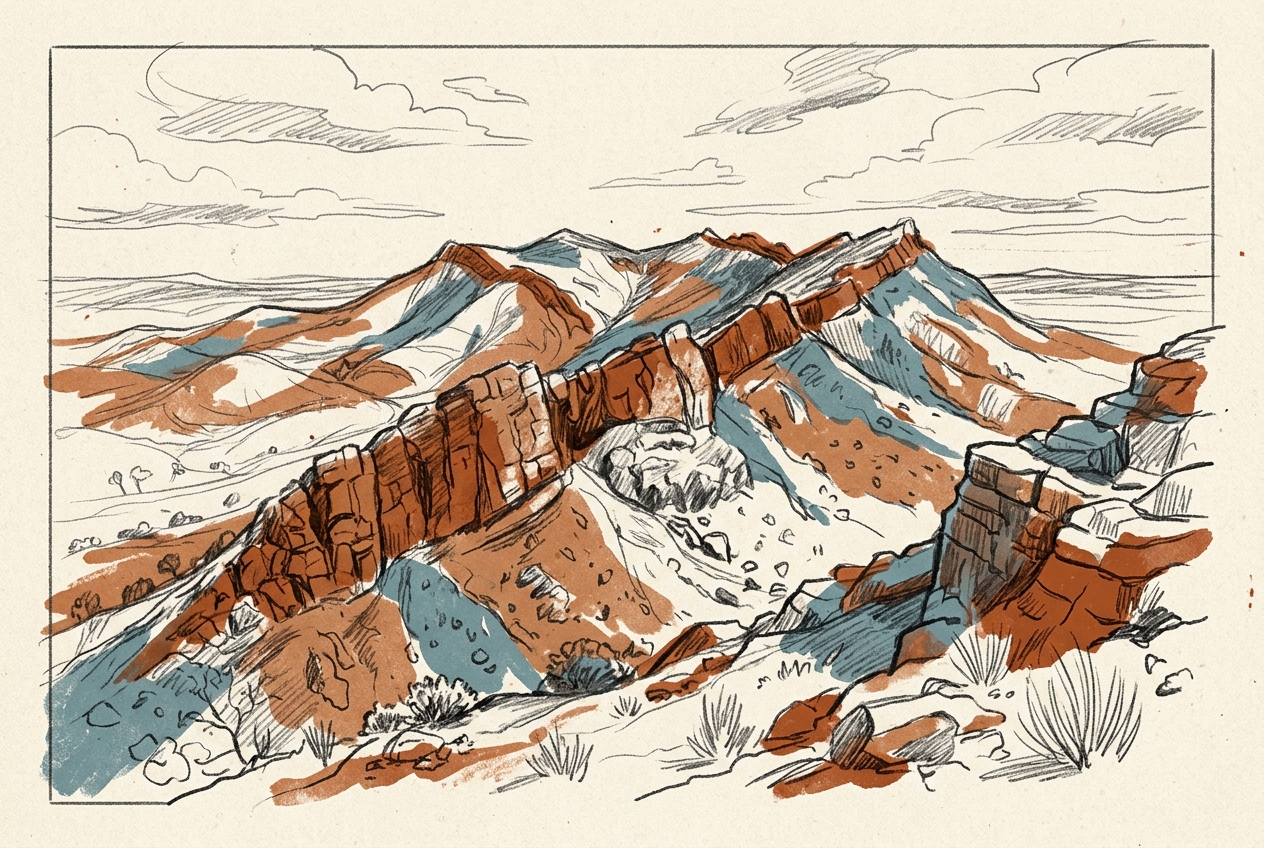
In Central Australia, 1.6-billion-year-old Stuart Pass diabase sills intruded ancient sediments and cooked them into quartzite, creating the rocky spine of the MacDonnell Ranges.
The MacDonnell Ranges rise from the desert like the bones of a buried continent. Their red quartzite ridges catch the morning light as if still hot from the kiln. And in a real sense, they are.
The Intrusion That Made Mountains Possible
The story begins 1.6 billion years ago, when a thick pile of sedimentary rock lay buried beneath Central Australia. These were the older sediments of the Arunta Block — sands and silts deposited in shallow seas and river plains, compacted into sandstone and shale.
Then came the diabase. Molten rock forced its way upward through fractures in the crust, spreading horizontally between sedimentary layers to form sills — tabular intrusions that can run for hundreds of kilometres. The Stuart Pass diabase sills are among the most extensive in Australia, some reaching 200 metres thick.
The heat was the crucial ingredient. As the diabase cooled slowly beneath the surface, it baked the surrounding sandstone, recrystallising the quartz grains into a dense interlocking fabric. Sandstone became quartzite. Ordinary sedimentary rock became armour.
The sills did not build the mountains. They made the mountains buildable.
The Compression That Raised the Ridge
For over a billion years, the quartzite layers lay buried. Then, around 400 million years ago, the Alice Springs Orogeny began. The Pacific and Australian plates collided, compressing Central Australia from north and south.
The ancient sediments folded and faulted. But the quartzite beds — hardened by Proterozoic heat — resisted erosion far better than the unaltered shales and sandstones around them. Where the softer rock wore away, the quartzite stood.
The result is a landscape of parallel ridges and valleys that runs east–west for 650 kilometres. The ridges are the exposed edges of folded quartzite layers. The valleys are the weathered remains of the weaker rock that once lay between them.
The Weathering That Coloured the Stone
The red that makes the MacDonnell Ranges so recognisable is not the quartzite itself. Quartzite is white, grey, or pale pink when fresh. The red comes from a thin veneer of iron oxide — a desert varnish that forms over tens of thousands of years as moisture evaporates from the rock surface, leaving a film of haematite.
This patina is fragile. Where water runs down the rock faces after rain, the varnish washes off, revealing the pale quartzite beneath. These dark streaks and light bands give the ranges their striped, layered appearance — a natural stratigraphy of weathering.
The same process has carved gaps and gorges through the ranges. Stand inside Standley Chasm on the West MacDonnell Ranges and the walls rise 80 metres above you, the light falling in a narrow slot. The chasm follows a fault line where the quartzite was fractured and the desert rain could do its slow work.
The Memory That Still Holds Shape
The Stuart Pass sills are no longer visible as igneous rock. They have been metamorphosed themselves, altered by the same orogeny that folded the ranges. But their effect persists in the profile of every ridge, the steepness of every gorge.
Driving the Larapinta Trail or flying over the Red Centre, you see the ranges as a series of sharp, parallel lines — the trace of a billion-year-old cooking event that made certain layers of the earth harder than their neighbours. Erosion did the rest.
The diabase sills of Stuart Pass did not create the MacDonnell Ranges. They created the difference that made the ranges possible. A difference in hardness, baked into the rock when the world was young, that the weather has been patiently revealing ever since.
More like this
- The 1.6-Billion-Year-Old Pillows That Still Rest on the SeafloorIn the McArthur Basin, 1.6-billion-year-old pillow basalts preserve the shape and chemistry of lava that erupted into a Proterozoic sea, recording the oxygen-poor ocean where the pillows still rest.
- The 180-Million-Year-Old Organ That Still Plays in the StoneTasmania's Organ Pipes are 180-million-year-old dolerite columns formed when Gondwana began to rift, now exposed as the frozen skeleton of a lost magma chamber.
- The 1.7-Billion-Year-Old Sill That Holds Sapphires in PlaceIn the Kimberley, 1.7-billion-year-old dolerite sills host sapphires that crystallised directly in volcanic fractures—a rare type of deposit formed in place, not washed into riverbeds.