11 July 2026 · 2 min read
The 1.7-Billion-Year-Old Sill That Holds Sapphires in Place
In the Kimberley, 1.7-billion-year-old dolerite sills host sapphires that crystallised directly in volcanic fractures—a rare type of deposit formed in place, not washed into riverbeds.
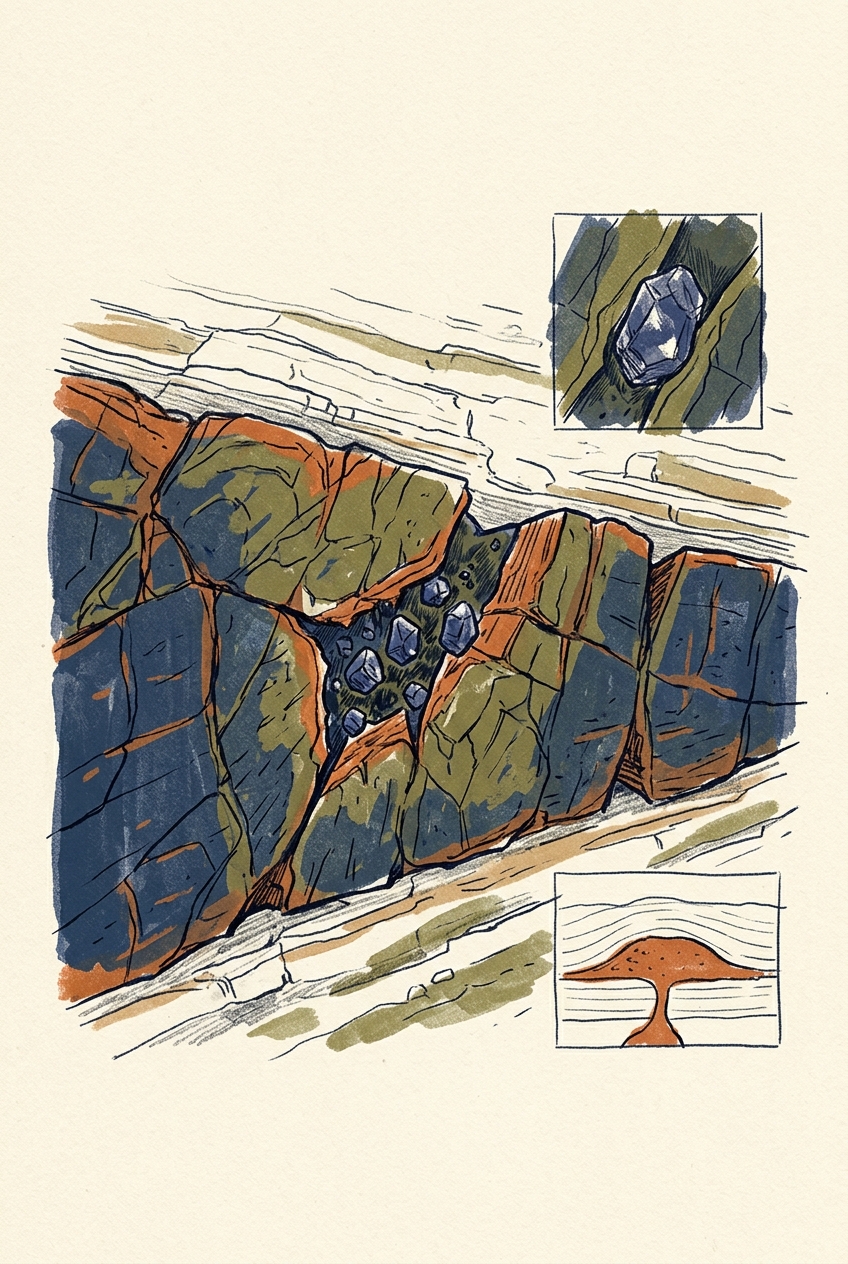
In the Kimberley region of Western Australia, a 1.7-billion-year-old volcanic rock called the Hart Dolerite contains the world's largest deposit of sapphire. The crystals grew not in magma chambers, but in the fractures of cooling lava—a process that remains poorly understood.
The Kimberley's Blue Secret
The sapphires of the East Kimberley are not found in alluvial gravels, like those of Sri Lanka or Myanmar. They are embedded in a 1.7-billion-year-old dolerite sill—a sheet of once-molten rock that intruded into older sediments and then cooled slowly beneath the surface. The host rock, the Hart Dolerite, extends across thousands of square kilometres of the remote Kimberley plateau. Prospectors discovered the sapphires in the 1980s, but mining has been sporadic and difficult. The deposits are scattered, the terrain harsh, and the crystals often small and fractured.
The sapphires grew in the cracks of a cooling world, not in the melt itself.
How Sapphires Grow in Volcanic Rock
Sapphire is a variety of corundum—aluminium oxide (Al₂O₃). It forms under high temperature and pressure, but rarely in the type of rock that hosts it here. Most sapphires on Earth come from secondary deposits: crystals weathered out of ancient basalt or metamorphic rocks and concentrated in riverbeds. The Kimberley sapphires are different. They crystallised directly within the Hart Dolerite, in gas cavities and fractures that formed as the sill cooled. Aluminium-rich fluids percolated through these cracks, depositing corundum in irregular, often colour-zoned crystals. The process required a specific chemical recipe: excess aluminium, low silica, and a slow cooling rate. The Hart Dolerite provided all three.
A Continent's Hidden Architecture
The Hart Dolerite is part of a larger story. It belongs to the 1.7-billion-year-old Warakurna large igneous province—a vast outpouring of magma that covered much of central and western Australia. The province is one of the largest volcanic events in Earth's history, spanning an area larger than Western Europe. Today, its remnants are exposed only in isolated outcrops: the Hart Dolerite in the Kimberley, the Giles Complex in the Musgrave Ranges, the Beda Volcanics in South Australia. The sapphires are a byproduct of this event—a minor mineralogical curiosity born from a planetary-scale process. The Warakurna event may have been triggered by a mantle plume, a rising column of hot rock from deep within the Earth. As the plume reached the base of the continent, it melted the crust and produced the dolerite sills that now host the sapphires.
The Unfinished Story
Despite decades of exploration, the Kimberley sapphire deposits remain poorly studied. The remote location and irregular distribution of the crystals make systematic mining uneconomical. Most production comes from small-scale prospectors and occasional mining leases. The crystals themselves are distinctive: they range from colourless to deep blue, often with strong colour zoning and inclusions of rutile needles. Some show the rare pink-orange colour known as padparadscha. The rough stones are typically small, rarely exceeding one carat. But their geological context is extraordinary—a sapphire deposit formed in place, in a billion-year-old volcanic rock, with no secondary transport or concentration. It is one of the few such deposits on Earth.
More like this
- The 50,000-Year-Old Ash That Still Holds Human HeatIn western Victoria, 50,000-year-old volcanic ash beds at Budj Bim preserve the oldest known human-modified landscape on Earth—a system of channels and ponds carved into basalt to trap eels.
- The 450-Million-Year-Old Volcano That Holds the Great Barrier ReefThe Great Barrier Reef grows on the eroded stumps of a 450-million-year-old volcanic arc that forms its hidden foundation.
- The 5,000-Year-Old Volcanoes That Still Smoke in the SouthIn Victoria's Newer Volcanics Province, 400 volcanic vents erupted as recently as 5,000 years ago—the youngest volcanic field in mainland Australia, where craters still hold blue lakes and scoria cone