11 July 2026 · 3 min read
The 1.1-Billion-Year-Old Sea That Left a Purple Bed
In the Amadeus Basin, a 1.1-billion-year-old salt lake deposited the Gillen Formation—a purple evaporite bed that still shapes Central Australian geology and water chemistry today.
Driving west from Alice Springs on a winter morning, the road cuts through a hill the colour of dried blood. The slope is not red dirt or ironstone. It is a billion-year-old salt pan, lithified into purple and maroon dolomite, and it once marked the edge of an inland sea that stretched farther than any Australian lake does today.
The Inland Sea That Never Saw the Coast
Around 1.1 billion years ago, central Australia lay beneath a shallow, restricted basin called the Amadeus Basin. The ocean had access, but barely. Evaporation repeatedly exceeded inflow, and the water grew so salty that calcium and magnesium carbonates precipitated directly onto the seafloor, layer after layer, for millions of years.
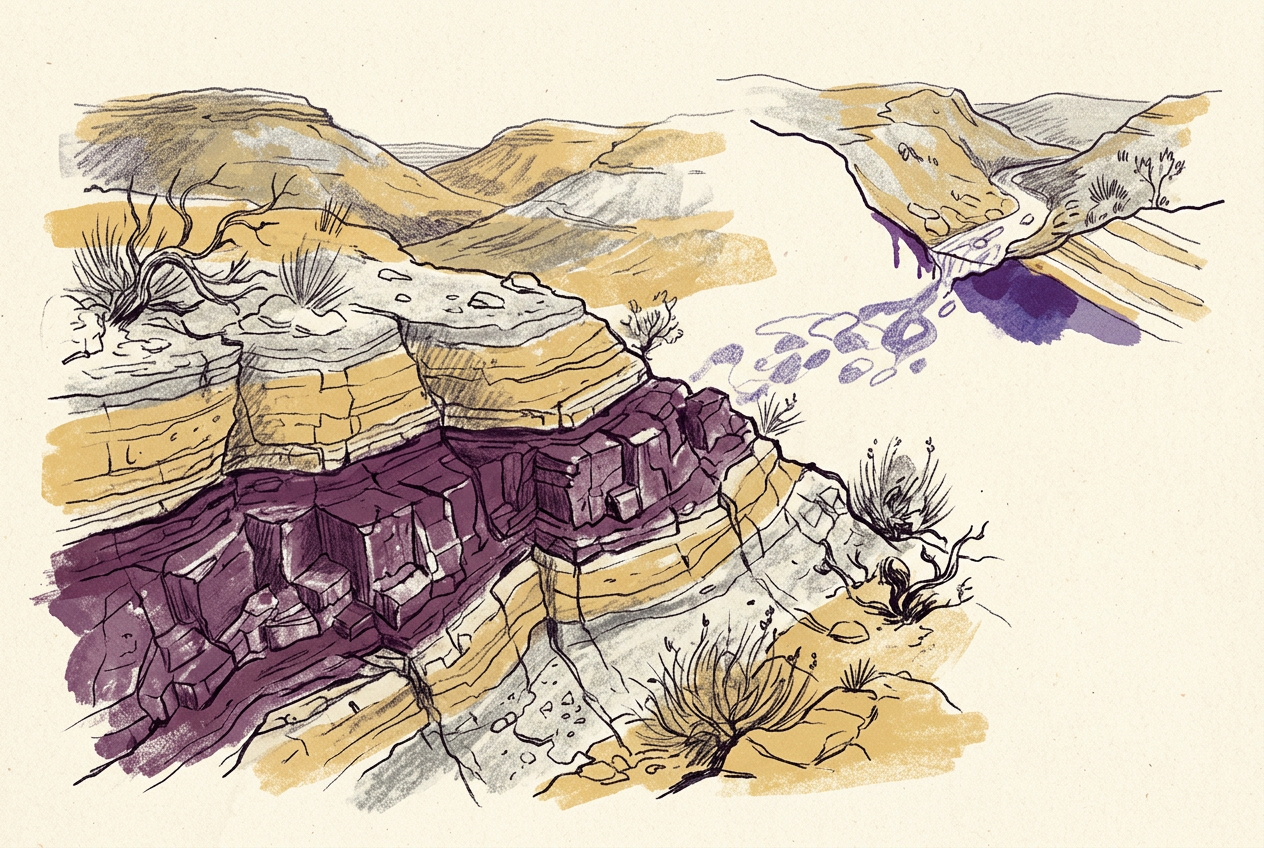
That deposit is now the Gillen Formation. It crops out in a rough arc from the West MacDonnell Ranges to the eastern edge of the Amadeus Basin, and its most striking member is a unit of purple dolomite called the Loves Creek Member. The colour comes from trace amounts of manganese and organic matter trapped in the crystal lattice — not from iron, which gives most of Australia's red rocks their hue.
The formation reaches about 1,200 metres thick in places. It represents roughly 200 million years of intermittent evaporation, flooding, and biological stagnation.
A billion years ago, this was a salt flat the size of Lake Eyre, repeating its own death and rebirth every few thousand years.
What the Purple Beds Preserve
The Gillen Formation contains some of the best-preserved Precambrian evaporite minerals on Earth. Halite casts, gypsum pseudomorphs, and anhydrite nodules are visible in outcrop, their original shapes intact despite a billion years of burial and uplift. In some beds, the crystal outlines of ancient salt hoppers — cubes that formed at the air-water interface — are still sharp enough to photograph.
These minerals record a specific kind of aridity. The sea did not simply dry up once. It cycled between hypersaline and slightly less hypersaline states, each pulse leaving a different mineral signature. The purple dolomite formed during the most concentrated phases, when microbial mats decayed in oxygen-starved water and released manganese into the precipitating carbonate.
Similar deposits occur in the Bitter Springs Formation, also in the Amadeus Basin, but the Gillen is thicker, older, and more intensely coloured. Geologists use it as a marker for the early tectonic history of central Australia, when the basin was still connected to a global ocean and the continent was part of Rodinia.
The Landscape That Refuses to Dissolve
The Gillen Formation does not erode softly. Dolomite is harder than limestone, and the purple beds stand as low ridges and breakaway scarps across the MacDonnell landscape. They form the dark bands visible in the walls of Ormiston Gorge and the steep flanks of Mount Gillen, the hill that overlooks Alice Springs from the north.
Rainwater, slightly acidic from atmospheric carbon dioxide, dissolves the dolomite along fractures. This produces a peculiar micro-relief: sharp-edged rills, solution pits, and small karst features that never develop into proper caves because the rock is too impure. The manganese stains bleed into the runoff, giving seasonal creeks a faint violet tint after storms.
The formation also controls groundwater chemistry. Boreholes drilled into the Gillen encounter brine with total dissolved solids exceeding 100,000 milligrams per litre — three times saltier than seawater. That water is undrinkable, but it carries a chemical signature that traces back to the Neoproterozoic sea, still circulating through the same pores it occupied a billion years ago.
A Quiet Archive
The Gillen Formation is not dramatic. It does not contain fossils, gold, or tourist lookouts. It is a purple rock in a red desert, easily driven past. But it records something rare: a billion-year interval when nothing much happened, when a shallow sea simply evaporated, again and again, and left its chemistry in the ground. That kind of patience is hard to find in the rock record. Central Australia kept the receipts.
More like this
- The 555-Million-Year-Old Wrinkle That Records the First MuscleA 555-million-year-old Ediacaran fossil from the Flinders Ranges preserves the oldest evidence of muscle contraction—an animal that could shrink to one-fifth its resting size.
- The 50,000-Year-Old Ash That Still Holds Human HeatIn western Victoria, 50,000-year-old volcanic ash beds at Budj Bim preserve the oldest known human-modified landscape on Earth—a system of channels and ponds carved into basalt to trap eels.
- The 540-Million-Year-Old Footprints That Record the First WalkersIn South Australia's Grindstone Range, 540-million-year-old footprints record the oldest known evidence of walking—animals with legs crossing a quiet shoreline before predators existed.