14 July 2026 · 4 min read
The 1.7-Billion-Year-Old Bacteria That Built a Mountain
In Western Australia's Hamersley Range, 1.7-billion-year-old stromatolites from the Duck Creek Formation record the oldest known freshwater reef—built by cyanobacteria, not corals.
On the southern edge of the Hamersley Range, a low ridge of grey dolomite rises from the red earth. It looks unremarkable—just another slab of Proterozoic rock in a landscape built from older, grander things. But this rock was built by microbes.
The Duck Creek Formation is 1.7 billion years old. It runs in a narrow band through the eastern Pilbara, and it preserves something rare: the oldest known freshwater reef on Earth. Not a coral reef, not a sponge reef, but a reef of stromatolites—layered mounds built by photosynthetic bacteria that once covered the floor of an ancient lake.
The Lake That Lived in the Sun
The Pilbara of 1.7 billion years ago was not the red desert it is today. It was a landscape of shallow lakes, fed by rainfall and groundwater, sitting on an already ancient crust. In one of those lakes, conditions were just right for cyanobacteria.
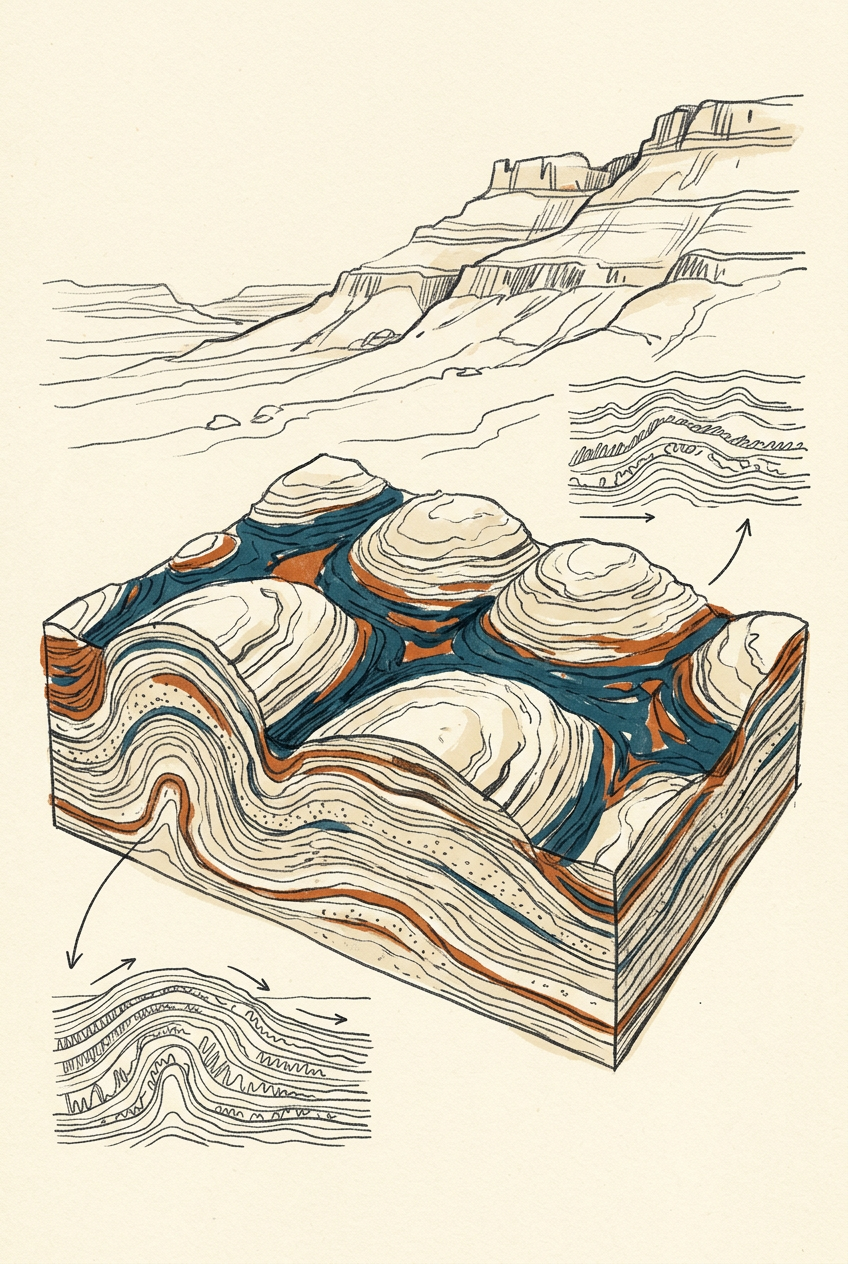
These microbes did not build skeletons. They grew as thin, sticky mats on the lakebed, trapping grains of sediment. Each layer of sand and silt was cemented by the bacteria's own secretions, then overgrown by the next generation. Over centuries, these mats stacked into dome-shaped structures—some no bigger than a fist, others the size of a car.
What makes the Duck Creek stromatolites unusual is the water they grew in. Most stromatolites from this era formed in shallow seas. These grew in fresh water, at a time when life had barely begun to colonise the continents. The lake was probably alkaline, rich in dissolved calcium and magnesium, which helped the microbial mats lithify into solid dolomite.
A Reef Without Animals
The Duck Creek reef supported no fish, no shellfish, no coral polyps. The only animals alive on Earth at the time were single-celled eukaryotes and tiny plankton—nothing that could graze on the bacterial mats or bore into the rock.
This absence of grazing pressure is probably why the stromatolites grew so large. In younger reefs, animals would have cropped the microbial mats, keeping them thin and low. Here, the bacteria grew unchecked, building structures that rose metres above the lakebed. The reef was a city with no predators, no competition, no tenants—just the builders themselves, stretching toward the light.
The domes show fine laminations, visible in cross-section as alternating light and dark bands. Each band represents a growth cycle—perhaps daily, perhaps seasonal. Some layers are smooth and regular; others are wrinkled, disturbed by storms or changes in water chemistry. The rock preserves the pulse of a lake that no longer exists.
The reef was a city with no predators, no competition, no tenants—just the builders themselves.
The Quiet Endurance of Microbes
Stromatolites were the first visible life on Earth, appearing in rocks 3.5 billion years old in the Pilbara's own Dresser Formation. By 1.7 billion years ago, they were already past their peak. The Duck Creek reef is a late bloomer—a remnant of a world that was slowly disappearing.
As grazing animals evolved and spread through the oceans, stromatolites retreated to extreme environments: hypersaline lagoons, alkaline lakes, hot springs. They survive there today, living refuges of a Precambrian way of life. But the Duck Creek reef was built before any of those pressures existed, in a lake where bacteria could still rule without challenge.
The rock itself has changed little since it formed. The dolomite is fine-grained, grey-brown on fresh surfaces, weathering to a pale buff. It still holds the shapes of the ancient mounds—rounded, overlapping, sometimes branching. You can walk across the outcrop and see the reef's structure laid out in plan view, the domes preserved like a field of frozen cobblestones.
What the Rock Remembers
The Duck Creek Formation is not as famous as the Pilbara's older stromatolites, or the banded iron formations of the Hamersley Range. It sits in the shadow of rocks twice its age and formations that built an entire mining industry. But it records a quieter piece of history: the moment when life first spread into the continents' interior waters.
Before the Duck Creek lake, freshwater environments may have been largely sterile—too harsh, too variable, too poor in nutrients. The cyanobacteria that built this reef proved that life could thrive there, laying down sediment, altering water chemistry, creating the first inland ecosystems. They were preparing the continents for the green invasion that would come hundreds of millions of years later.
The reef still stands in the Pilbara heat, a dome-shaped fossil of a vanished lake. It was built by creatures with no organs, no nerves, no individual identity—just the blind industry of photosynthesis, stacking one grain at a time, for centuries, until they raised a mountain from the mud.
More like this
- The 550-Million-Year-Old Quilt That Learned to MoveIn South Australia's Flinders Ranges, 550-million-year-old Dickinsonia fossils preserve the oldest known mobile animals—soft-bodied creatures that fed by absorbing nutrients through their quilted surf
- The 500-Million-Year-Old Sponge That Grew a Glass SkeletonIn South Australia's Flinders Ranges, 500-million-year-old hexactinellid sponges built skeletons of silica glass, recording the moment when life learned to mine the sea for minerals.
- The 650-Million-Year-Old Glaciers That Scratched a ContinentIn the Flinders Ranges, 650-million-year-old glacial deposits record the Sturtian Snowball Earth, with striated pavements and dropstones that prove Australia once lay under kilometres of ice near the