17 May 2026 · 4 min read
The Volcano That Built a Nickel Mine: Western Australia's Kambalda Dome
How 2.7-billion-year-old Archean komatiite lavas in Western Australia's Kambalda Dome concentrated nickel sulphides into one of the world's richest ore systems.
Beneath the red dust of Western Australia's Goldfields, sixty kilometres south of Kalgoorlie, a 2.7-billion-year-old lava flow holds one of the richest concentrations of nickel on Earth. The Kambalda Dome is not a volcano in any familiar sense. It is the crumpled remnant of an Archean volcanic system that erupted under an ancient ocean, and its lavas were hot enough to melt the rock they flowed across — a property that made them, over geological time, into a nickel factory.
The Hottest Lava on Earth
The lavas that built Kambalda are called komatiites, named after the Komati River in South Africa where they were first identified. Komatiites are ultramafic — meaning they contain very little silica and abundant magnesium — and they erupted at temperatures exceeding 1600 degrees Celsius, roughly 300 degrees hotter than any modern basalt flow. At those temperatures, the lava was as fluid as water, spreading in thin sheets across the Archean seafloor.
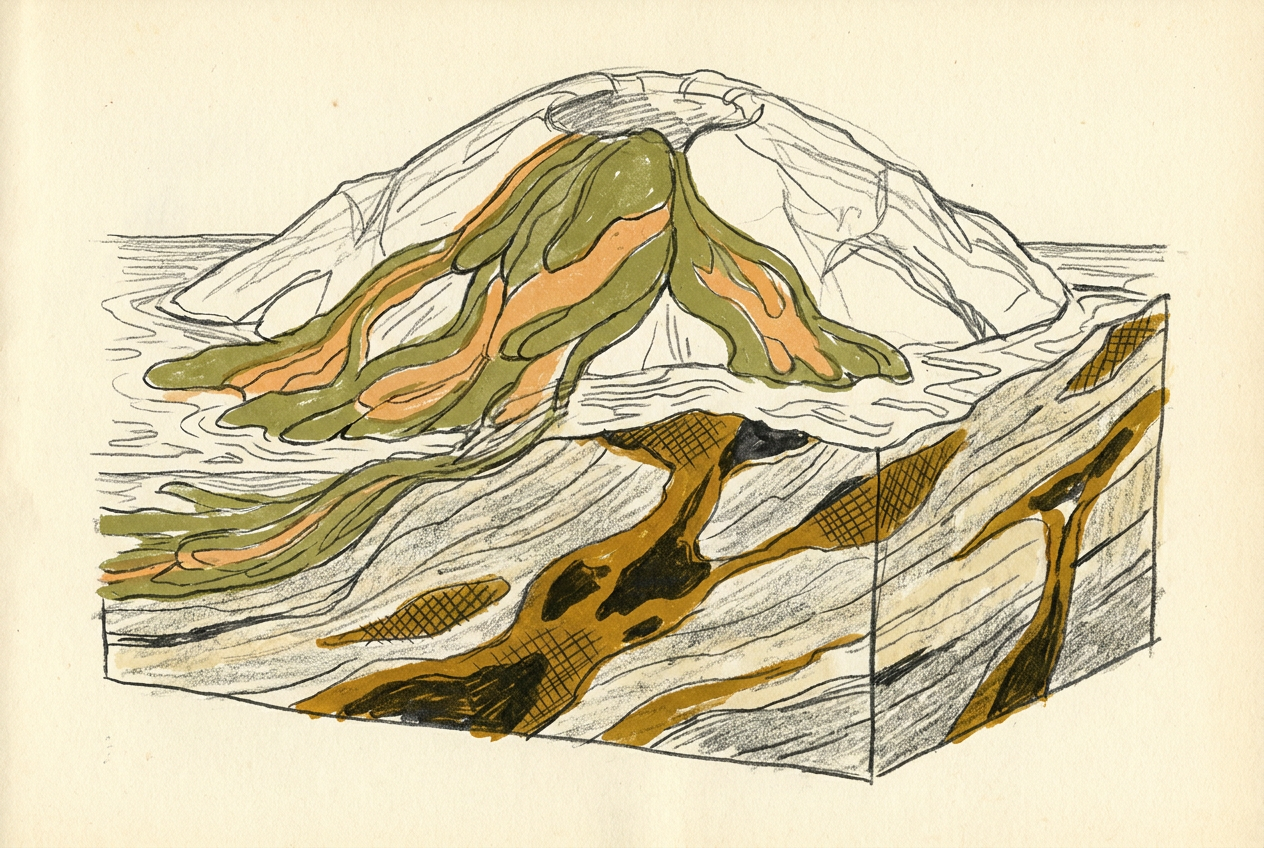
What makes komatiites exceptional, however, is not their heat but their chemistry. As they flowed, they assimilated sulphur from the sulphide-rich sediments beneath them. Molten nickel sulphide droplets separated from the cooling lava, sank to the base of the flow, and pooled in topographic lows. The result was a deposit of immense economic concentration: nickel sulphide ore grading between 2 and 4 percent, sometimes higher.
The Kambalda Dome preserves more than fifty separate ore shoots, each a frozen stream of liquid sulphide that accumulated in depressions on the ancient seafloor. Miners have extracted over 1.5 million tonnes of nickel metal from these shoots since production began in 1967.
A Dome of Deformation
The Kambalda Dome is not a volcanic crater but a structural dome, formed when the Archean crust was compressed during the Yilgarn Orogeny around 2.65 billion years ago. The komatiite flows, originally laid flat on the seafloor, were folded into a broad arch. Erosion stripped away the top of the arch, exposing the flows in cross-section — a geological accident that made the ore accessible.
Walking across the Kambalda Dome today, you see outcrops of dark, weathered komatiite. The rock is dense and heavy, pitted with rusty patches where nickel sulphides have oxidised. The flows are thin — typically five to fifty metres thick — but they extend laterally for kilometres, stacked one above another like pages in a book. Each flow represents a separate eruption, and each has its own ore potential.
The komatiite flows at Kambalda are so well preserved that geologists can still identify the original chill margins — the glassy rinds that formed when molten lava hit cold seawater 2.7 billion years ago.
Why It Matters
Kambalda is not the only komatiite-hosted nickel deposit in the world, but it is among the richest. Its discovery in the 1960s transformed Western Australia's mining industry and turned the Yilgarn Craton into a global nickel province. The deposits at Kambalda, together with those at Mount Keith and Leinster, have produced more than five million tonnes of nickel metal.
Nickel is essential to the modern world. It is a key component of stainless steel and, increasingly, of the lithium-ion batteries that power electric vehicles. The Kambalda ore, with its high nickel content and relatively low processing cost, has become more valuable as the world shifts toward electrification. Yet the geology that created it is ancient — a record of a time when the Earth's mantle was hotter, its crust thinner, and its volcanoes more extreme than anything we see today.
The komatiites also tell a deeper story. They are evidence that plate tectonics was operating in the Archean, though differently than now. The Kambalda lavas erupted in a submarine setting analogous to modern back-arc basins, where extension of the crust allowed mantle-derived magmas to reach the surface. The fact that such rocks survive at all, after 2.7 billion years of deformation, metamorphism, and erosion, is remarkable.
The Future of an Ancient Lava
Kambalda's mines have been operating for more than half a century, and the deposits are not exhausted. New discoveries continue to be made beneath the dome, where deeper drilling has intercepted ore shoots at depths exceeding 1,500 metres. The komatiite sequence extends downward for several kilometres, and much of it remains unexplored.
What makes Kambalda enduring is the same thing that made it rich: the extraordinary heat of Archean lavas, the sulphur they scavenged from the seafloor, and the tectonic forces that folded everything into a dome. It is a story of extreme temperatures, liquid sulphide, and 2.7 billion years of patience — a reminder that the most valuable geological deposits are often the ones that formed under conditions the modern Earth no longer provides.
More like this
- The 5,000-Year-Old Volcanoes That Still Smoke in the SouthIn Victoria's Newer Volcanics Province, 400 volcanic vents erupted as recently as 5,000 years ago—the youngest volcanic field in mainland Australia, where craters still hold blue lakes and scoria cone
- The 300-Million-Year-Old Forest That Died Standing UpIn New South Wales, a 300-million-year-old fossil forest preserves dozens of trees buried upright by a Permian volcanic eruption—an entire ecosystem frozen in ash.
- The 1.85-Billion-Year-Old Caldera That Still Feeds the FurnaceIn South Australia's Middleback Ranges, a 1.85-billion-year-old volcanic caldera collapsed and later became one of the world's richest iron ore deposits.