17 May 2026 · 3 min read
The Lake That Became a Diamond Pipe: South Australia's Eurelia Volcanic Field
How 170-million-year-old Jurassic volcanoes in South Australia's Flinders Ranges erupted through ancient lake beds, creating one of the continent's most unusual diamond deposits.
Near the small town of Eurelia in South Australia's Flinders Ranges, a farmer drilling for water in the 1970s struck something unexpected: diamonds. The stones were small, mostly industrial-grade, but their presence in the arid pastoral country was a geological puzzle. The source was not a classic Kimberley-style pipe but something rarer — a Jurassic volcanic field that had punched through ancient lake sediments 170 million years ago, bringing fragments of the mantle to the surface in a way that Australia has not seen since.
The Lake That Preceded the Volcanoes
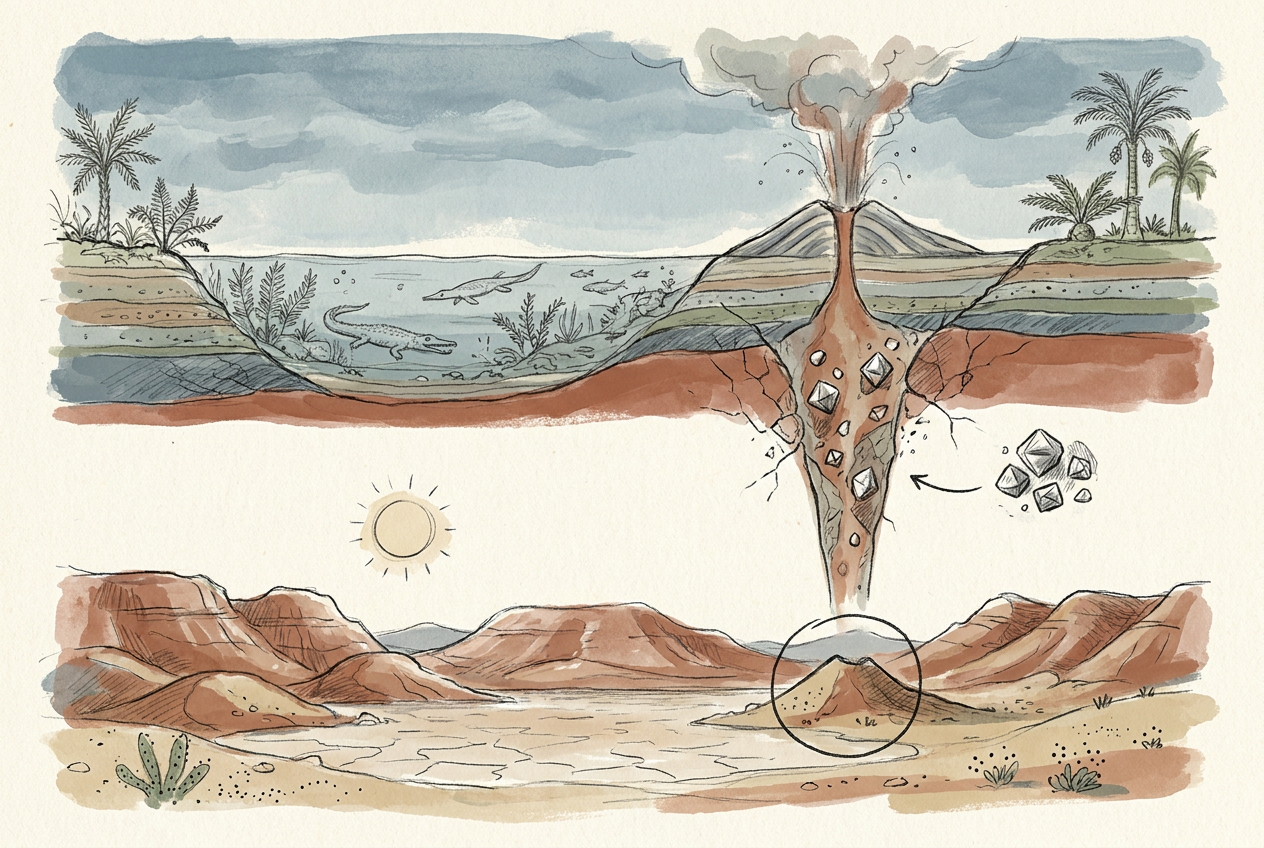
In the early Jurassic, the Flinders Ranges did not exist. The landscape was flat, dominated by a vast inland lake — Lake Eurelia — that stretched across what is now South Australia's mid-north. The lake deposited layers of silt, sand, and clay that later hardened into the sedimentary rocks visible in the region today.
These lake beds are not merely background scenery. They are the reason the diamonds survived. When the volcanoes erupted, the rising magma passed through the damp, poorly consolidated sediments, which acted as a shock absorber. The eruptions were explosive — phreatomagmatic, driven by steam when molten rock met groundwater — but the soft lake beds prevented the violent fragmentation that would have destroyed the diamonds.
The result was a series of small volcanic vents, known as diatremes, that preserved their cargo of mantle-derived crystals intact.
What the Volcanoes Brought Up
The Eurelia volcanic field consists of at least 15 separate vents, each a pipe-like body filled with volcanic breccia — angular fragments of rock blasted from the conduit walls and mixed with magma. The diamonds themselves are tiny, typically less than a millimetre across, and most are pale yellow or brown. They formed in the mantle more than 150 kilometres beneath the surface, under immense pressure and temperature, before being carried upward by the Jurassic magma.
But the Eurelia pipes are unusual for more than their preservation. They also contain fragments of lower-crustal rocks — granulites and eclogites — that record the deep geology of the Australian continent. These xenoliths have allowed geologists to study the composition of the crust beneath the Flinders Ranges without drilling a single deep hole.
The Eurelia diamonds did not arrive in a single dramatic eruption. They arrived in a series of small, wet explosions that left behind not a mountain but a scattering of low hills.
A Landscape of Small Explosions
The vents are not obvious from the ground. Most are less than 200 metres across, and many have been eroded to shallow depressions or low ridges. The largest, known as the Eurelia pipe, is about 150 metres in diameter and rises only a few metres above the surrounding plain. It is marked by a scatter of greenish volcanic rock — lamproite — that weathers to a distinctive yellow-brown soil.
Exploration in the 1980s and 1990s confirmed that the diamonds occur at low grades — a few carats per hundred tonnes of rock — too sparse for economic mining. But the scientific value is significant. The Eurelia field is one of the few places on Earth where Jurassic diamond-bearing volcanism can be studied in its original sedimentary context.
The field also hints at a broader story. Across the Flinders Ranges, other small volcanic vents of similar age have been found, suggesting that a substantial Jurassic volcanic province once existed here, now largely eroded away. The Eurelia pipes are its surviving roots.
What the Pipes Tell Us About Australia
The Eurelia volcanic field offers a window into two distinct moments in Australia's deep history. The first is the Jurassic, when the continent was still part of Gondwana and a series of small volcanoes erupted across a landscape of lakes and floodplains. The second is the present, when 170 million years of erosion have stripped away the volcanic cones and exposed the pipes beneath.
The diamonds themselves are messengers from deeper time. Their ages, measured from inclusions of mantle minerals, suggest they crystallised more than a billion years ago — making them far older than the volcanoes that brought them to the surface. They are fragments of an ancient keel beneath the continent, a thick, cold root of mantle that stabilised the Australian crust long before the first animals evolved.
Today, the Eurelia pipes sit quietly in sheep paddocks, their diamonds hidden in weathered rock. They are a reminder that the most valuable geological stories are not always the ones that made someone rich. Sometimes they are the ones that simply survived.
More like this
- The 5,000-Year-Old Volcanoes That Still Smoke in the SouthIn Victoria's Newer Volcanics Province, 400 volcanic vents erupted as recently as 5,000 years ago—the youngest volcanic field in mainland Australia, where craters still hold blue lakes and scoria cone
- The 560-Million-Year-Old Garden That Never Saw a PredatorIn South Australia's Flinders Ranges, 560-million-year-old Ediacara surfaces preserve entire seafloor communities of fronds, discs, and quilts — a garden of soft-bodied life that flourished before pre
- The 300-Million-Year-Old Forest That Died Standing UpIn New South Wales, a 300-million-year-old fossil forest preserves dozens of trees buried upright by a Permian volcanic eruption—an entire ecosystem frozen in ash.