8 May 2026 · 3 min read
The Vertical Sea: The Deep Roots of Uluru
An exploration of the tectonic forces and sedimentary history that created Uluru, the Red Centre's massive arkose monolith.
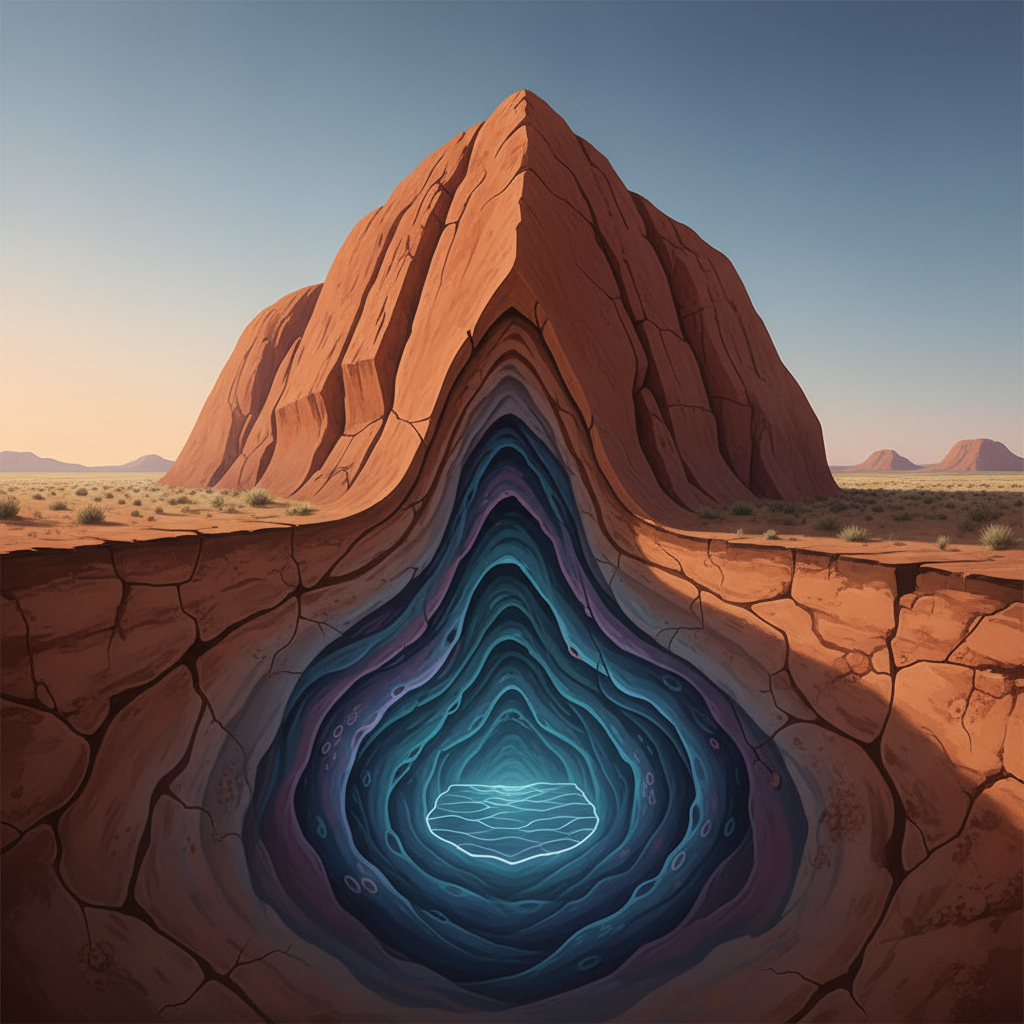
In the arid expanse of the Amadeus Basin, a single monolith of arkose sandstone rises 348 meters above the desert floor, yet its visible bulk is merely the tip of a colossal tectonic iceberg. Most of Uluru remains buried, a vertical slab of stone extending five or six kilometers into the crust like a buried tooth.
The Petermann Orogeny
The story of Uluru begins approximately 550 million years ago, during the Neoproterozoic. To the southwest of what is now the Red Centre, a massive mountain-building event known as the Petermann Orogeny was underway. These mountains were once as high as the Himalayas, a jagged spine of rock that dominated the interior of the supercontinent Gondwana.
As these mountains rose, they were immediately attacked by the relentless forces of erosion. Without land plants to stabilize the soil or soften the blow of tropical storms, the granite peaks shed their skin rapidly. Immense volumes of sediment—gravel, sand, and silt—were washed down into nearby depressions.
One of these depressions was the Amadeus Basin. Here, the debris settled in vast alluvial fans. The specific sediment that would become Uluru was an arkose: a coarse-grained sandstone rich in the mineral feldspar. This high feldspar content suggests the sediment was buried quickly, before the mineral had time to weather into clay.
The Folding of the Bed
For millions of years, these alluvial fans lay flat, accumulating under their own weight. Then, around 400 to 300 million years ago, a second geological upheaval called the Alice Springs Orogeny buckled the region. The horizontal layers of the Amadeus Basin were compressed, folded, and tilted.
In most places, sedimentary strata are gently warped. At Uluru, the forces were so intense that the entire block was tilted nearly 90 degrees. The layers of sand that once lay flat on the basin floor were turned on their side, standing almost vertically.
The rock is not a bubble or a volcanic plug; it is the exposed edge of a subterranean sheet, a page of a book turned upright and weathered at the margin.
Because the arkose is remarkably uniform and lacks the major joints or fractures common in the surrounding plains, it resisted erosion better than the softer rocks around it. As the softer landscape washed away over the last 60 million years, the hard, vertical ribs of the arkose were left standing in high relief. This process, known as inselberg formation, created the "island mountain" we see today.
The Chemistry of Red
The most striking feature of Uluru is its shifting color, which transitions from a dusty grey to a glowing burnt orange as the sun sets. This is a superficial transformation. If you were to break open a fresh piece of the rock, the interior would be a dull, metallic grey.
The red skin is the result of chemical weathering. The iron-bearing minerals within the arkose react with oxygen and water in the atmosphere, creating a coating of iron oxide—essentially rust. This oxidation layer is only a few millimeters thick, a delicate patina protecting the unweathered core beneath.
- Composition: 50% feldspar, 25–35% quartz, and fragments of basalt and granite.
- Structure: The vertical layers, or bedding planes, are clearly visible as ribs along the flanks of the rock.
- Erosion: Rainfall creates temporary waterfalls that carve deep grooves and "potholes" in the summit, slowly widening the natural weaknesses in the stone.
The caves and hollows at the base of the rock, such as the Mutitjulu Waterhole, are formed by a process called cavernous weathering. Moisture seeps into the rock and dissolves the mineral cement holding the sand grains together. Over centuries, sections of the stone flake away or collapse, leaving behind the scalloped undercuts and smooth alcoves that have provided shelter for the Anangu people for tens of thousands of years. Uluru is a monument to the endurance of sand, turned to stone and thrust into the light.
More like this
- The 110-Million-Year-Old River That Runs Backwards UndergroundWestern Australia's 110-million-year-old dune system has been slowly dissolving into a labyrinth of caves where an ancient river still flows, carrying the taste of a Cretaceous desert.
- The 5,000-Year-Old Volcanoes That Still Smoke in the SouthIn Victoria's Newer Volcanics Province, 400 volcanic vents erupted as recently as 5,000 years ago—the youngest volcanic field in mainland Australia, where craters still hold blue lakes and scoria cone
- The 560-Million-Year-Old Garden That Never Saw a PredatorIn South Australia's Flinders Ranges, 560-million-year-old Ediacara surfaces preserve entire seafloor communities of fronds, discs, and quilts — a garden of soft-bodied life that flourished before pre