13 May 2026 · 3 min read
The Stromatolite City: Shark Bay's Living Reefs
In Western Australia's Shark Bay, living stromatolite mounds built by microbes grow today much as they did 3.5 billion years ago, offering a rare window into Earth's earliest life.
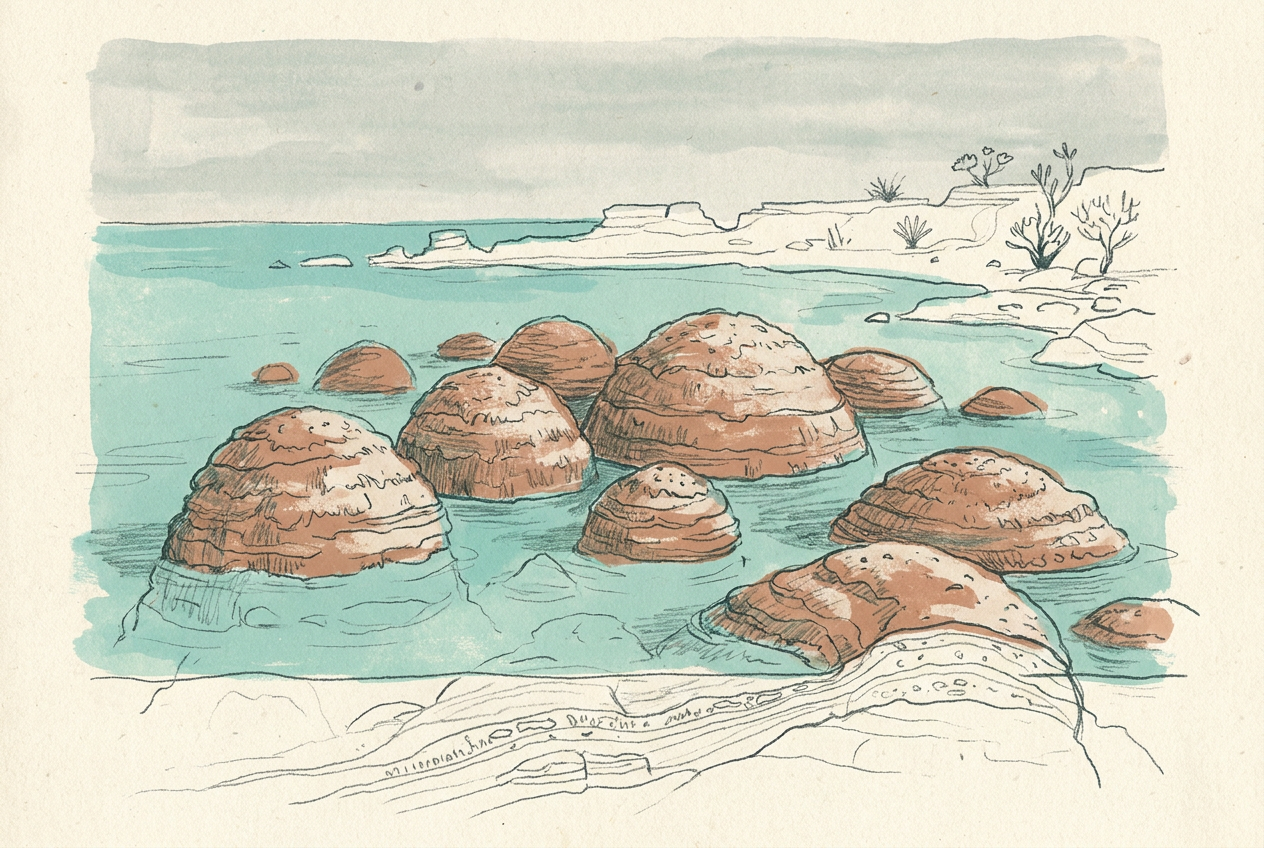
At Hamelin Pool, in the shallows of Western Australia's Shark Bay, the water is twice as salty as the open ocean and the seafloor is not stone but something older. Rounded grey domes rise from the brine like loaves of bread set out to cool. They are not rock, though they feel like it. They are alive.
These are living stromatolites—microbial mats that trap and bind sediment into layered structures, the same way Earth's earliest ecosystems did for most of the planet's history. Shark Bay contains the most extensive living stromatolite system on Earth, a rare glimpse of the biological engine that built the first reefs.
The Microbial Architects
A stromatolite looks like a cabbage carved from concrete, but its surface is a living skin of cyanobacteria—photosynthetic microbes that form a sticky biofilm. Each day, the microbes trap grains of carbonate sand; each night, calcium carbonate precipitates within the mat, cementing the layer in place. Over years, these daily increments stack into columns.
The Hamelin Pool stromatolites are not fossils. They are active communities, growing roughly 0.3 millimetres per year. A dome one metre across has been building for more than 3,000 years. The oldest known stromatolite fossils, found in the Pilbara's 3.5-billion-year-old Dresser Formation, look almost identical to these living forms.
The same biological process that built the first reefs on Earth is still running in a hypersaline lagoon on Australia's west coast.
Why Shark Bay?
Stromatolites once dominated the shallow seas of the Archaean and Proterozoic. Then grazing organisms evolved—snails, worms, crustaceans—and ate the mats faster than they could grow. By the Cambrian Period, stromatolites had retreated to refuges where grazers could not survive.
Shark Bay is one such refuge. The waters of Hamelin Pool are isolated by a shallow sill and the long bar of the Faure Sill, which restricts tidal exchange. Evaporation concentrates the salt to twice normal ocean levels—too salty for most grazing molluscs. Without predators, the microbial mats flourish.
The bay itself is young by geological standards. The modern stromatolite fields began growing about 2,000 years ago, when rising sea levels flooded the shallow basin. In that short time, the microbes have built structures up to 1.5 metres tall, accreting sediment into shapes that mimic the ancient world.
What the Layers Record
Cut a stromatolite open, and the internal banding reveals a record of its environment. Dark layers mark periods of rapid growth; light bands show slower, drier seasons. The structure traps grains of quartz, fragments of shell, and the chemical signals of the water in which it grew.
In ancient stromatolites, these layers preserve evidence of Earth's earliest atmospheres. The 2.7-billion-year-old stromatolites of the Tumbiana Formation, northeast of Shark Bay, contain organic matter that records the metabolic activity of the first oxygen-producing organisms. They are indirect evidence—but powerful evidence—that photosynthesis was running long before the Great Oxidation Event changed the planet's air.
Shark Bay's living mounds allow scientists to test those interpretations. By studying how modern microbes trap sediment, researchers can read the fossil record with greater confidence. The present, in this case, really does explain the past.
A Fragile Archive
The Hamelin Pool stromatolites are protected within the Shark Bay World Heritage Area, but they remain vulnerable. A drop in salinity—from floodwaters or altered tidal flow—could allow grazing snails to return. The microbial mats grow too slowly to recover from disturbance. A single footprint in the crust can take decades to heal.
The stromatolites persist because conditions remain extreme. They survive at the edge of what life can tolerate. That is how life began on Earth—not in comfortable seas, but in brines and shallows where nothing else could live. Shark Bay preserves not just a living fossil, but the original strategy of survival.
More like this
- The 560-Million-Year-Old Garden That Never Saw a PredatorIn South Australia's Flinders Ranges, 560-million-year-old Ediacara surfaces preserve entire seafloor communities of fronds, discs, and quilts — a garden of soft-bodied life that flourished before pre
- The 300-Million-Year-Old Forest That Died Standing UpIn New South Wales, a 300-million-year-old fossil forest preserves dozens of trees buried upright by a Permian volcanic eruption—an entire ecosystem frozen in ash.
- The 1.75-Billion-Year-Old Reef That Outranks the BarrierA 1.75-billion-year-old microbial reef in the Kimberley is the largest biological structure ever built by a single species, preserving a world without predators.