13 May 2026 · 3 min read
The Diamond Gravels of Copeton: How Garnets Reveal a Lost Continent
Beneath NSW's Copeton dam, diamond-bearing gravels contain garnet crystals that match rocks under Antarctica, revealing a 300-million-year-old vanished landmass.
In the 1970s, when the Copeton dam wall was being raised near Inverell in northern New South Wales, bulldozers pushed aside gravels that miners had picked over for decades. The gravels held diamonds—small, pale, and stubbornly unhelpful to geologists trying to work out where they came from. The nearest known kimberlite pipes, the volcanic necks that carry diamonds from the mantle, were hundreds of kilometres away. The Copeton diamonds, it seemed, had no parent.
The Garnet That Didn't Belong
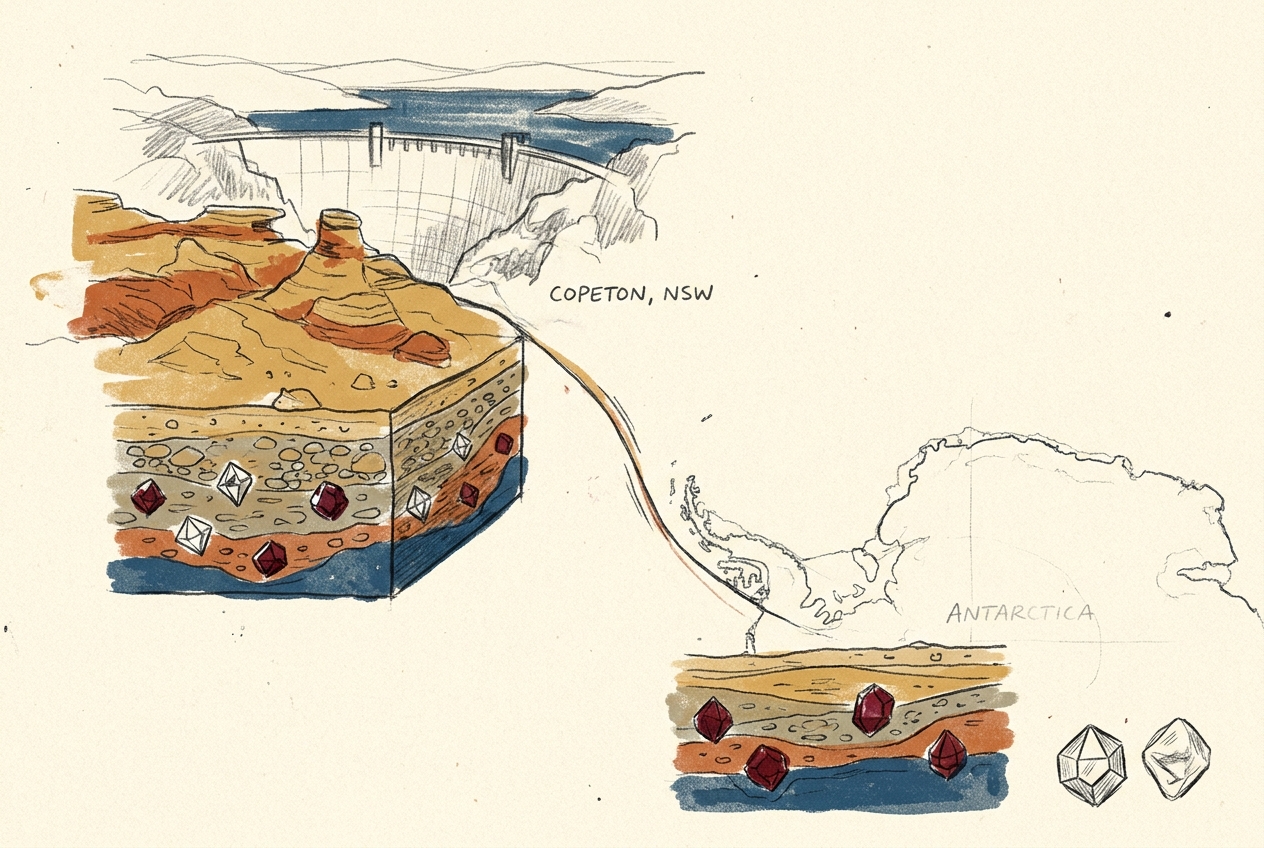
The Copeton dam gravels are part of an ancient drainage system that once flowed across eastern Australia. The diamonds occur alongside heavy minerals—zircon, ilmenite, and most tellingly, garnet. In the 1990s, geologists led by Peter Sutherland at the Australian National University began analysing the trace-element chemistry of those garnets. They found something unexpected.
The garnets matched a specific kind of mantle rock—a depleted, high-pressure garnet lherzolite—that does not occur beneath eastern Australia today. The chemical fingerprint pointed to a source region that had been thick, cold, and ancient, like the lithosphere beneath a continental craton. But there was no craton nearby.
The closest match was the crust beneath Antarctica.
A River That Crossed a Continent
The only explanation that fits the evidence is that the Copeton diamonds and their accompanying garnets were carried by a river system that no longer exists. During the Permian, around 280 million years ago, eastern Australia was part of the supercontinent Gondwana. Antarctica lay directly to the south, and the two landmasses were joined along what is now the eastern seaboard.
A river draining the Antarctic interior—from a region geologists call the Nimrod Complex in the Transantarctic Mountains—flowed north across the join, across what would become New South Wales, and emptied into a shallow sea. Along the way, it eroded diamond-bearing kimberlite pipes and dumped the heavy minerals in gravel bars. When Gondwana broke apart, starting around 180 million years ago, the river's middle and upper reaches were carried away with Antarctica. Only the downstream end remained, scattered across the New England tablelands as lag gravels.
The Copeton diamonds are not Australian. They are Antarctic stones that happened to be left behind when two continents divorced.
A Lost Landscape in a Grain of Sand
The Copeton gravels are what geologists call a "palaeoplacer"—a fossilised river deposit preserved by burial and subsequent exhumation. The diamonds themselves are small, typically less than one carat, and often show signs of transport: rounded edges, frosted surfaces, and percussion marks from bouncing along a riverbed for hundreds of kilometres.
But the real prize is the garnet. Each grain carries a record of the mantle from which it was torn—the temperature, pressure, and composition of a piece of Earth's interior that no longer exists beneath Australia. The Nimrod Complex, the likely source, contains some of the oldest rocks on Earth, including 3.9-billion-year-old gneisses. The diamonds that travelled from there to Copeton may have crystallised in the mantle over three billion years ago, been carried up in a kimberlite eruption during the Devonian, and then sat in a riverbed for another 250 million years before a bulldozer blade scraped them into a pile.
What the Gravels Still Hold
The Copeton field has produced around 500,000 carats of diamonds since mining began in the 1860s, mostly from alluvial deposits worked by hand and later by dredge. The source kimberlite pipes have never been found—they were carried away with Antarctica. But the gravels continue to yield scientific insight.
Recent studies of helium isotopes in the Copeton diamonds suggest they formed in a mantle domain that has remained isolated from convection for over three billion years. The diamonds are time capsules from a deep Earth reservoir that has since been recycled or homogenised.
The Copeton gravels are a reminder that the Australian continent is a fragment of something larger, and that the evidence for what was lost is sometimes small enough to fit in a jeweller's loupe.
More like this
- The 560-Million-Year-Old Garden That Never Saw a PredatorIn South Australia's Flinders Ranges, 560-million-year-old Ediacara surfaces preserve entire seafloor communities of fronds, discs, and quilts — a garden of soft-bodied life that flourished before pre
- The 1.75-Billion-Year-Old Reef That Outranks the BarrierA 1.75-billion-year-old microbial reef in the Kimberley is the largest biological structure ever built by a single species, preserving a world without predators.
- The 3.5-Billion-Year-Old Cones That Still Catch LightIn the Pilbara's Dresser Formation, 3.5-billion-year-old stromatolites preserve the oldest direct evidence of life on Earth—microbial mats that built layered domes in a volcanic caldera.