12 May 2026 · 4 min read
The Lithium That Leached: The Greenbushes Pegmatite
In Western Australia's Greenbushes, a 2.5-billion-year-old pegmatite vein—one of the world's largest lithium deposits—formed when extreme magmatic concentration left behind a rare cache of spodumene.
Halfway between Perth and the southwest coast, a shallow pit cuts into jarrah forest. The rock exposed there is not spectacular—pale grey, coarse-grained, veined with white—but it holds more lithium than almost any other known body on Earth. The Greenbushes pegmatite is a deposit formed by an accident of extreme concentration, and it has quietly supplied the world's lithium for decades.
The Anatomy of a Pegmatite
Pegmatites are the last gasp of a cooling granite. As a large body of magma crystallises deep underground, most minerals solidify early, removing common elements like iron and magnesium from the melt. What remains is a residual fluid rich in water, rare elements, and incompatible atoms that do not fit into the crystal structures of common rock-forming minerals. This watery slurry, still at several hundred degrees Celsius, can remain mobile long after the surrounding granite has hardened.
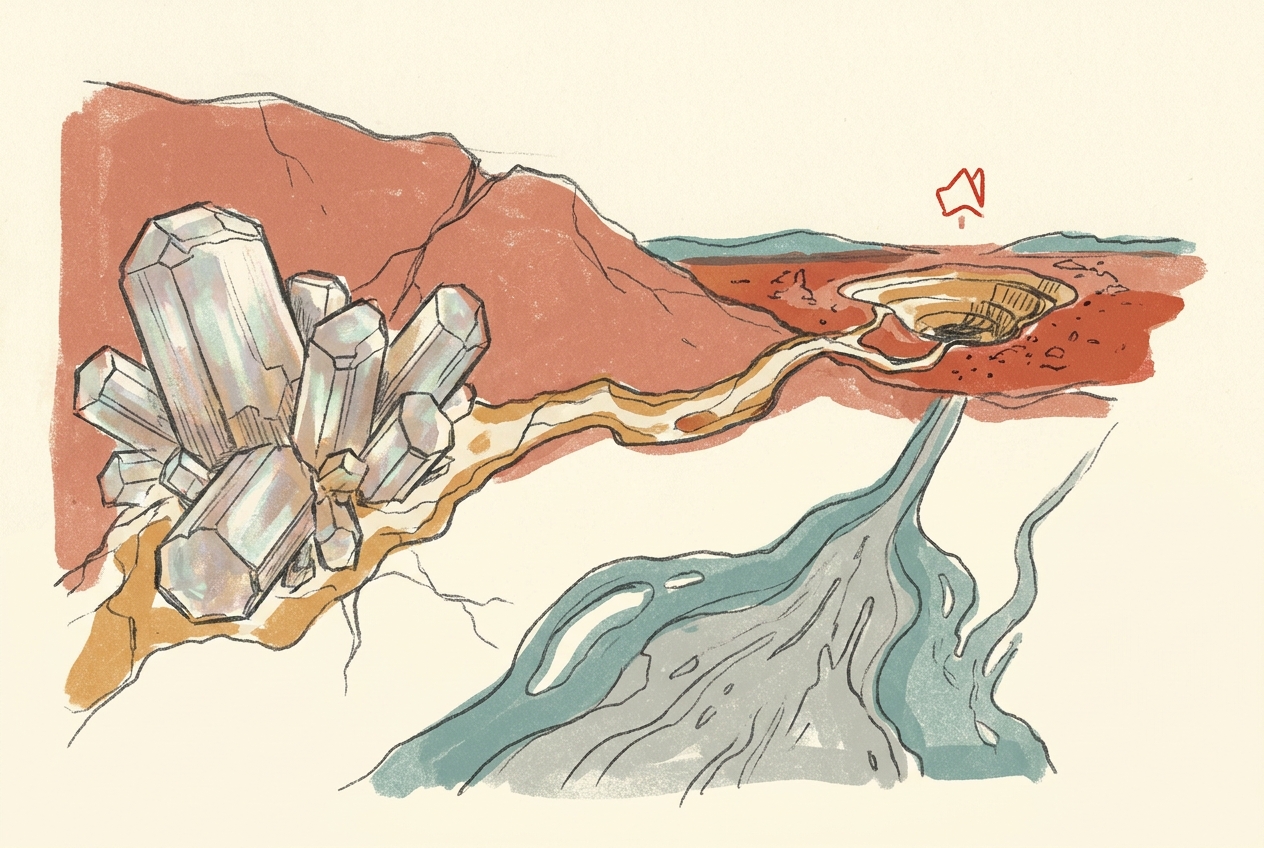
At Greenbushes, that residual fluid forced its way into fractures in the surrounding greenstone and gneiss roughly 2.5 billion years ago. The result was a dyke—a sheet of igneous rock cutting across older formations—but one with an extraordinary composition. Instead of the typical quartz and feldspar, the Greenbushes pegmatite is packed with spodumene: a lithium aluminium silicate that can contain up to 8 percent lithium oxide by weight.
The deposit is not a single vein but a swarm of them, stacked like blades in a knife block, extending over three kilometres along strike and to depths of at least 600 metres. The largest single pegmatite body is up to 100 metres thick.
How Concentration Happens
Lithium is not rare in the Earth's crust. It is about as abundant as lead or cobalt. But it is rarely concentrated enough to mine. The reason lies in its geochemical behaviour: lithium ions are small and highly charged, so they tend to remain dispersed in silicate melts rather than precipitating into early-forming minerals. Only when a magma has crystallised to less than 10 percent of its original volume does the remaining fluid become enriched enough to form spodumene.
At Greenbushes, the process appears to have been unusually efficient. The parent granite—part of the Yilgarn Craton's southwestern margin—was itself rich in lithium, and the pegmatite fluids migrated along a structural corridor that focused them into a narrow zone. The result is a deposit where lithium grades average around 2 percent lithium oxide, roughly double the grade of most other hard-rock lithium mines.
The spodumene crystals themselves can be enormous. Individual prisms up to two metres long have been recorded, their striated faces gleaming with a faint pearlescent sheen. In thin section, they show the characteristic cross-fracture pattern that makes spodumene easy to identify under a microscope.
A pegmatite is what happens when a magma refuses to give up its last, strangest children.
The Longer Story of a Rare Rock
Although Greenbushes is often described as a lithium mine, the pegmatite also contains significant amounts of tantalum, tin, and caesium. Tantalum, in particular, is concentrated in the mineral tantalite, which occurs as small black grains scattered through the spodumene-rich zones. These accessory minerals tell a broader story: the residual fluid that formed the pegmatite was so enriched that it captured not just lithium but nearly every incompatible element in the original magma.
The deposit was discovered in the 1880s, when tin miners followed alluvial cassiterite up the Greenbushes Creek to its source. They dug shallow pits by hand, carting ore in horse-drawn wagons to a nearby battery for crushing. For decades, the mine produced only tin and tantalum; the lithium-rich spodumene was considered waste rock.
That changed in the 1990s, when demand for lithium-ion batteries began to grow. Today, the Greenbushes pit is the world's largest hard-rock lithium operation, supplying nearly a third of global production. The spodumene concentrate is shipped to refineries in China and Australia, where it is converted into lithium hydroxide and lithium carbonate.
What the Pegmatite Leaves Behind
Mining a pegmatite is straightforward—blast, crush, grind, float—but the waste stream is enormous. For every tonne of spodumene concentrate produced, roughly six tonnes of tailings are left behind. These tailings are not inert: they contain residual mica, feldspar, and quartz, along with traces of the tantalum and tin that the processing plant does not fully capture.
The pit itself will eventually reach the limits of the pegmatite body, and the operation will shift underground. Below the current open cut, the dyke continues downward, narrowing but still rich. The geological accident that created Greenbushes was a single event, 2.5 billion years ago, and it will not repeat. The mine is drawing down a finite inheritance of concentrated lithium that took billions of years to assemble.
It is worth pausing on that. The lithium in a single electric vehicle battery passed through a chain of unlikely events: the crystallisation of a granite batholith, the focusing of a residual melt, the slow cooling of a pegmatite dyke, and then a century of mining, processing, and transport. The rock itself is ordinary—coarse, grey, unremarkable. What makes it extraordinary is the concentration, and concentration is always the rarest thing in geology.
More like this
- The 2.5-Billion-Year-Old Volcano That Still Holds 3,000 Tonnes of CopperIn South Australia's Olympic Dam, a 2.5-billion-year-old volcanic-hydrothermal system created the largest uranium deposit on Earth and a copper resource so vast it reshaped an industry.
- The 3.5-Billion-Year-Old Lava That Still Tastes of the MantleIn the Pilbara, 3.5-billion-year-old komatiite lavas preserve the chemical fingerprint of the Earth's pristine mantle—unaltered by plate tectonics or crustal contamination.
- The 2.5-Billion-Year-Old Ash That Mapped a Craton's HeartHow 2.5-billion-year-old volcanic ash beds in Western Australia's Pilbara Craton became the continent's oldest geological clock—zircons that date the birth of continental crust itself.