16 May 2026 · 3 min read
The Reef That Wasn't: South Australia's Ediacaran Sponge Grounds
In the Flinders Ranges, 550-million-year-old rocks preserve what may be Earth's oldest animal fossils—not reefs or worms, but the impressions of sea-floor sponges that lived in deep, dark water.
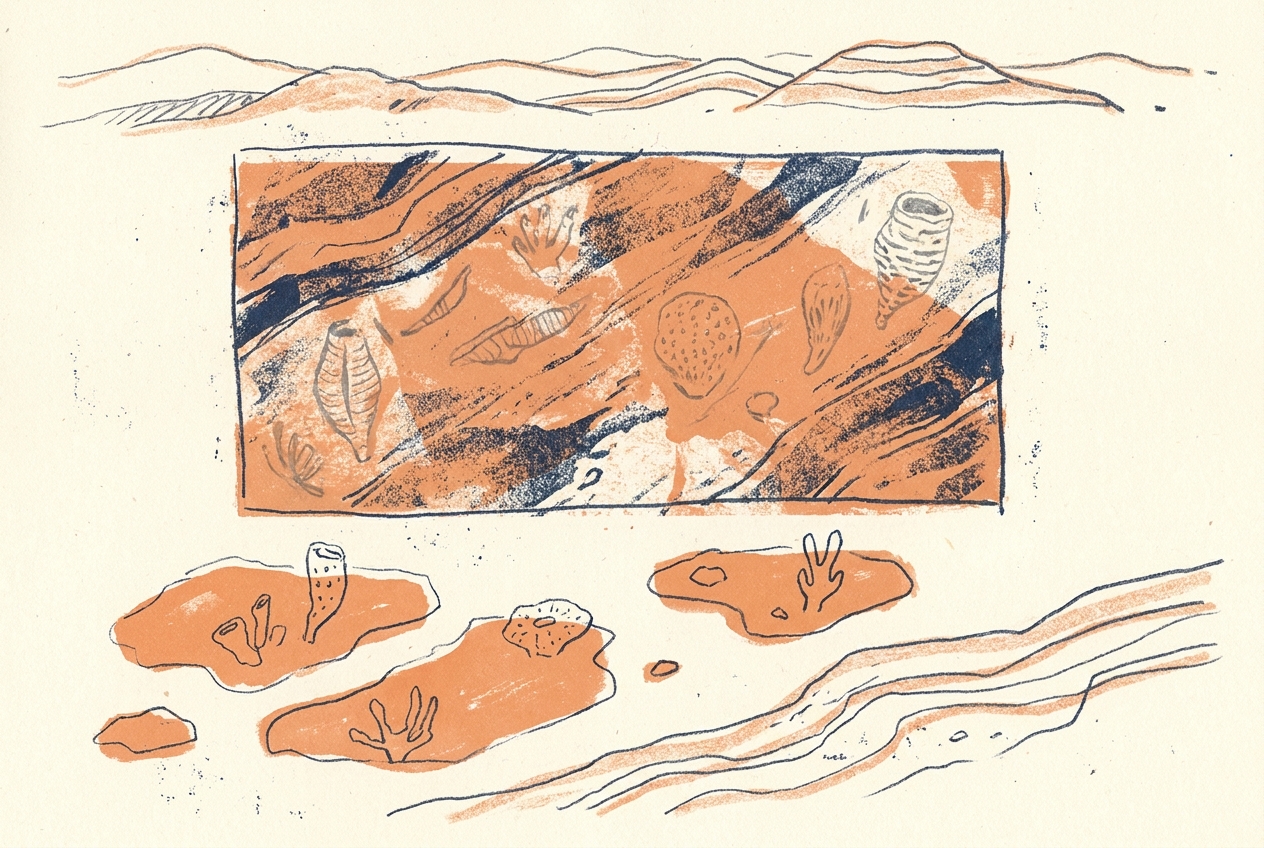
On a hillside in the Flinders Ranges, the rock surface is covered in what look like small, deflated balloons. They are not fossils in the usual sense—no bone, no shell, no hard parts at all. These are the impressions of bodies that had no skeletons, preserved because sand filled their cavities before they rotted. They are 550 million years old, and they may be the oldest animals ever found.
The site is called Nilpena, a fossil bed in South Australia's Flinders Ranges, about 500 kilometres north of Adelaide. Here, the Ediacara Member of the Rawnsley Quartzite has yielded thousands of specimens of the Ediacaran biota—the first complex life on Earth. But unlike some better-known Ediacaran sites, Nilpena preserves something peculiar: vast fields of Dickinsonia and other soft-bodied organisms, but also curious, disc-shaped forms that have long puzzled palaeontologists.
The Deep-Water Riddle
For decades, the conventional view held that Ediacaran organisms lived in shallow, sunlit seas, perhaps as photosynthetic mats or lichen-like colonies. The problem is that the Nilpena fossils are preserved in sandstones that were deposited by turbidity currents—underwater avalanches of sediment that only occur in deep water, below the reach of waves and sunlight. The rocks show no evidence of algae, no ripple marks from shallow tides, and no trace of the microbial mats that typically bind shallow sea floors.
In 2021, a team led by Dr. Amelia Penny of the University of Oxford proposed a different interpretation. The disc-shaped fossils, they argued, were not animals at all in the modern sense, but the holdfasts of ancient sponges—organisms that anchored themselves to the sea floor and filtered nutrients from the dark water. If correct, this would push the oldest confirmed sponge fossils back by at least 40 million years, and reshape our understanding of when animal life first appeared.
"These were not reefs or gardens. They were sponge grounds—quiet, deep-water communities that lived in total darkness, fed by organic particles drifting down from above."
What the Sponges Tell Us
The fossils at Nilpena are preserved as casts and moulds in fine sandstone. The disc-shaped impressions, known as Aspidella, range from a few millimetres to several centimetres across. They often show a central depression and radial wrinkles, consistent with a soft, bag-like body that collapsed after death. Some specimens preserve what appear to be spicules—the tiny silica needles that give sponges their structure—though these are poorly preserved and controversial.
If the Nilpena fossils are indeed sponges, they reveal a world very different from the one we inhabit. The Ediacaran sea floor, 550 million years ago, was a quiet, muddy expanse where the only complex life was soft-bodied and sessile. No predators, no burrowers, no shells. These sponges would have fed by pumping water through their bodies, straining out bacteria and organic detritus—much as sponges do today.
But there is a deeper implication. Sponges are the most primitive branch of the animal family tree, diverging before the evolution of nerves, muscles, or organs. If they existed in the Ediacaran, then the evolutionary split between sponges and all other animals happened earlier than the fossil record currently shows—perhaps as far back as 700 million years ago.
A Window Before the Explosion
The Nilpena fossil bed is now part of the Ediacara Conservation Park, protected from mining and development. In 2023, the South Australian government announced a $1.5 million grant to build a covered walkway over the most productive fossil surface, allowing researchers to study the site without exposing the delicate impressions to weather and foot traffic.
The site continues to yield surprises. In 2024, a team from the University of Adelaide described a new species from Nilpena—a frond-like organism they named Nilpenia rossi, after the station owner who first noticed the fossils. It grew to half a metre tall and appears to have been anchored by a bulbous holdfast, much like the sponge discs.
What makes Nilpena special is not just its age, but its mode of preservation. The turbidity currents that killed these organisms also buried them instantly, in sand that later turned to quartzite. The result is a three-dimensional snapshot of a sea floor that existed before the Cambrian explosion, before predation, before skeletons—a world where the only animals were filter-feeders, drifting in the dark.
The deflated balloons on the hillside are not relics of a failed experiment. They are the foundations on which every later animal, including us, was built.
More like this
- The 560-Million-Year-Old Garden That Never Saw a PredatorIn South Australia's Flinders Ranges, 560-million-year-old Ediacara surfaces preserve entire seafloor communities of fronds, discs, and quilts — a garden of soft-bodied life that flourished before pre
- The 300-Million-Year-Old Forest That Died Standing UpIn New South Wales, a 300-million-year-old fossil forest preserves dozens of trees buried upright by a Permian volcanic eruption—an entire ecosystem frozen in ash.
- The 1.75-Billion-Year-Old Reef That Outranks the BarrierA 1.75-billion-year-old microbial reef in the Kimberley is the largest biological structure ever built by a single species, preserving a world without predators.