16 May 2026 · 3 min read
The Lava That Built a Reef: Victoria's Devonian Volcanoes
In central Victoria, 400-million-year-old volcanic islands became the foundation for one of the world's best-preserved Devonian coral reefs, now exposed in limestone quarries.
A coral reef once grew on the slopes of an active volcano. Today, both are stone.
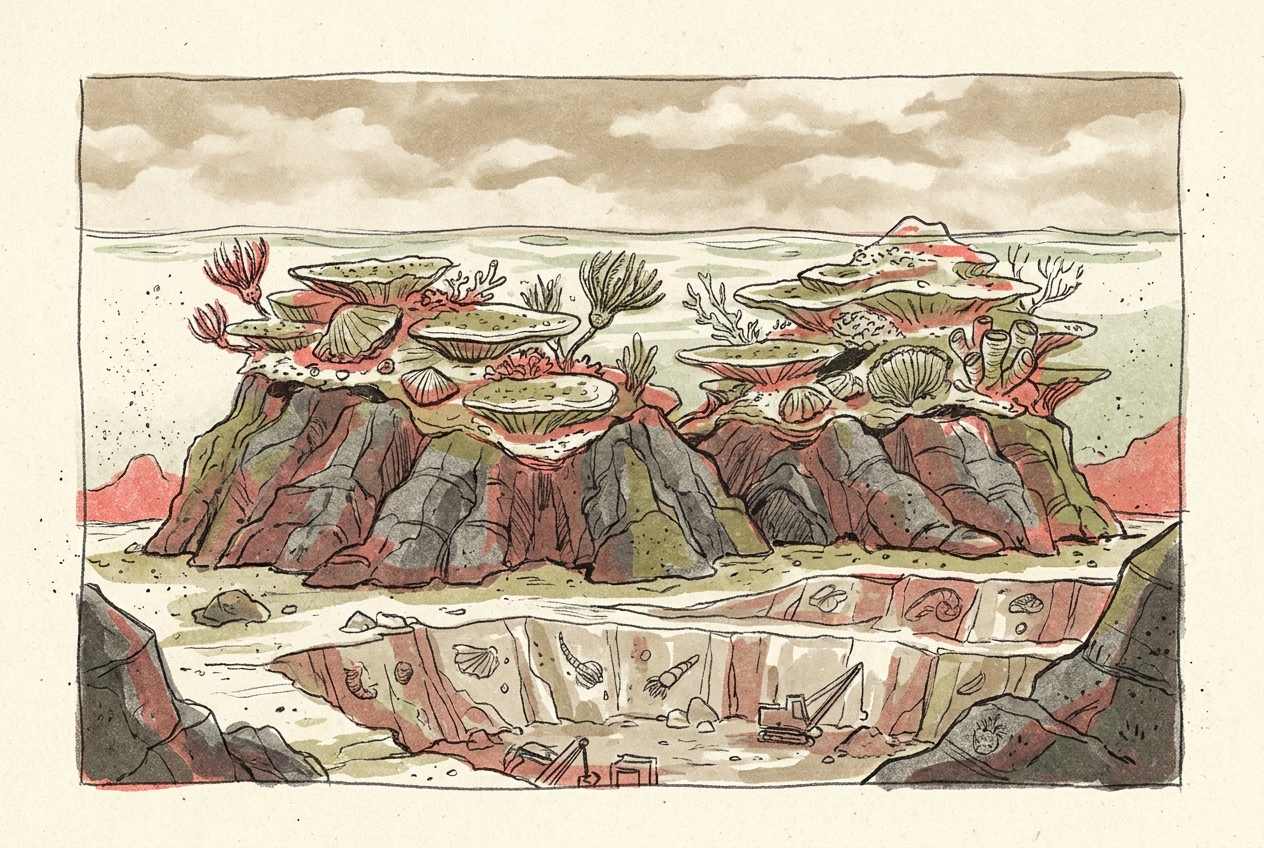
In central Victoria, near the town of Lilydale, limestone quarries expose a 400-million-year-old fossil reef that built itself atop the submerged flanks of a Devonian volcano. The volcanoes are long gone. The reef remains, its coral heads and seafloor sediments locked in pale limestone that was once a shallow tropical sea.
The Volcano That Became an Island
During the Devonian Period, around 400 million years ago, eastern Australia sat closer to the equator than it does today. A chain of volcanic islands stretched across what is now Victoria, part of a complex arc system where oceanic crust was subducting beneath the ancient continent of Gondwana.
These volcanoes erupted mostly underwater, but some built their cones above the waves, forming islands not unlike the modern Sunda Arc of Indonesia. The Lilydale volcano was one such island. As its eruptions waned and the volcanic rock cooled, the island became a stable platform in warm, sunlit seas — precisely the conditions that coral reefs require to grow.
Lava and limestone have a strange intimacy. The reef could not have formed without the volcano, yet the volcano's own rock is almost invisible, buried beneath the skeletons of millions of animals that colonised its slopes.
The Reef That Grew on a Slope
What the Lilydale quarries preserve is not a single reef but a series of reef communities that grew and shifted as the volcanic landscape subsided. Corals, stromatoporoids (sponge-like organisms), and calcareous algae built wave-resistant structures in the shallow waters around the island.
The limestone is full of fossils. Solitary cup corals, branching colonies, and massive dome-shaped stromatoporoids lie packed together in beds up to 30 metres thick. Brachiopods, crinoids, and trilobite fragments fill the spaces between. These are not rare, precious specimens — they form the bulk of the rock itself.
A single quarry wall can contain more individual organisms than the entire Great Barrier Reef of today, compressed into a few metres of stone.
The reef was not a single continuous ring around the island. Core samples and quarry exposures show patch reefs, lagoonal sediments, and deeper-water deposits arranged in a complex mosaic. The volcano's irregular shape, its bays and headlands, created microenvironments where different organisms flourished.
The Ash That Preserved the Reef
The reef might have been destroyed by later eruptions, but a different fate befell it. As the Devonian progressed, volcanic activity shifted elsewhere. The island subsided beneath the sea, and the reef was buried by fine-grained sediments — lime mud and volcanic ash — that smothered the corals but preserved their forms in exquisite detail.
Later, tectonic forces during the Carboniferous and Permian compressed and tilted these sediments. The limestone was metamorphosed slightly, recrystallising into a harder, denser rock. The fossils survived the pressure, their shapes etched into the stone by the contrast between original skeleton and surrounding matrix.
The Lilydale limestone was quarried extensively in the 19th and early 20th centuries for building stone and lime production. Quarry workers found coral heads so abundant and well-preserved that they used them as decorative garden ornaments. The site is now partly protected, though active quarrying continues nearby.
A Lost World in a Quarry Wall
The Lilydale reef is not Australia's oldest reef — that honour belongs to microbial structures in the Pilbara, 3.5 billion years old. Nor is it the largest. But it is one of the most accessible and complete Devonian reef complexes in the Southern Hemisphere, and it tells an unusual story: of life finding a foothold on the unstable slopes of an active volcano.
The volcano that built the island has eroded to almost nothing. Its lavas and tuffs are exposed in scattered outcrops, deeply weathered, easily overlooked. But the reef it supported remains, a limestone archive of a Devonian sea, visible in every quarry face and roadside cutting through the Lilydale hills.
Coral by coral, the stone records how a volcanic island became a reef, and how a reef became a hill in rural Victoria.
More like this
- The 5,000-Year-Old Volcanoes That Still Smoke in the SouthIn Victoria's Newer Volcanics Province, 400 volcanic vents erupted as recently as 5,000 years ago—the youngest volcanic field in mainland Australia, where craters still hold blue lakes and scoria cone
- The 560-Million-Year-Old Garden That Never Saw a PredatorIn South Australia's Flinders Ranges, 560-million-year-old Ediacara surfaces preserve entire seafloor communities of fronds, discs, and quilts — a garden of soft-bodied life that flourished before pre
- The 300-Million-Year-Old Forest That Died Standing UpIn New South Wales, a 300-million-year-old fossil forest preserves dozens of trees buried upright by a Permian volcanic eruption—an entire ecosystem frozen in ash.