13 July 2026 · 3 min read
The 555-Million-Year-Old Worm That Taught the Earth to Crawl
A 555-million-year-old fossil from the Flinders Ranges preserves the trace of the first known burrowing animal—a tiny worm-like creature that learned to move.
The Fossil That Wriggled Like a Worm
In the Flinders Ranges, a 555-million-year-old fossil preserves the unmistakable trace of an animal that moved. Not drifted. Not swayed. Moved — with purpose, across a seafloor that had never known a footprint.
A Trace Before the Trace
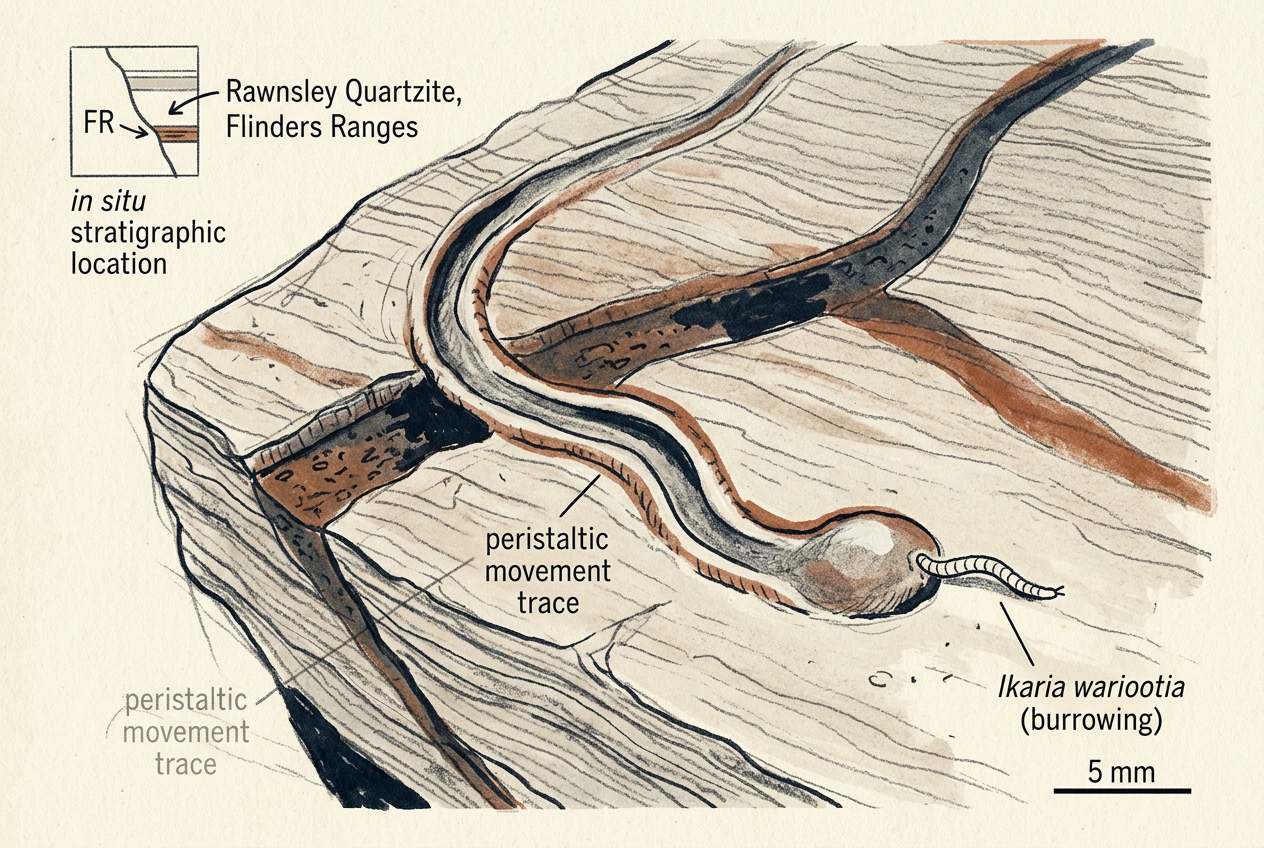
Fossils of the Ediacara biota are famously enigmatic. Most are fronds, discs, and quilts — organisms that sat fixed to the seafloor and fed from the water column. For decades, paleontologists debated whether any of them could move. Then, in 2018, a slab from the Nilpena Ediacara National Park revealed something else entirely: a long, sinuous impression, broken into repeating segments, that could only have been made by something crawling.
The fossil was named Ikaria wariootia. Each specimen is tiny — a few centimetres long at most — but the implication is enormous. Ikaria left a burrow. The burrow is a trace fossil, a record of behaviour rather than anatomy. The animal that made it had a front and a back, a left and a right, and the ability to contract its muscles in waves to push through sediment. That makes Ikaria one of the oldest known bilaterians — animals with bilateral symmetry, the body plan that would eventually produce almost everything on Earth that moves.
The First Worm
Ikaria lived about 555 million years ago, in the late Ediacaran Period. The seafloor at that time was a microbial mat — a leathery layer of cyanobacteria and other microbes that bound the sediment together. Most Ediacaran organisms sat on top of this mat. Ikaria burrowed into it.
The simplest form of locomotion is still a revolution, if nothing has ever walked before.
By wriggling through the sediment, Ikaria oxygenated the seafloor, churned organic matter, and created a new ecological niche. This was the first sediment-mixing — the first bioturbation — by a moving animal. Before Ikaria, the seafloor was a stable crust. After it, the seabed became a dynamic, churned world, and the chemistry of the oceans began to change.
What a Worm Means
Ikaria is a reminder that the history of movement on Earth is surprisingly short. For nearly three billion years, life was immobile — microbial mats, stromatolites, and single cells drifting in the water column. Then, in the last few million years of the Ediacaran, something learned to crawl. The transition was rapid and irreversible.
The fossils at Nilpena are preserved in fine-grained sandstone, which captured the burrows in three dimensions. Researchers have scanned them with CT imaging and confirmed that the tunnels are not mere surface scratches but true three-dimensional traces, consistent with an animal that had a mouth at one end and an anus at the other — a gut, in other words. That makes Ikaria the oldest confirmed bilaterian in the fossil record.
The Legacy
What became of Ikaria is uncertain. The Cambrian explosion, which began about 541 million years ago, produced a vast diversity of burrowing and swimming animals. By then, the worm-like body plan was already established. The first walkers, the first swimmers, and the first predators all owe something to that tiny Ediacaran worm that pushed against the mud and found it could move.
Today, the Nilpena fossil surfaces lie protected within the newly expanded national park. Visitors can see the slabs, tilted and exposed, where the trace of the first animal to walk the Earth — or wriggle beneath it — is still visible in the stone.
More like this
- The 1.1-Billion-Year-Old Meteorite That Left No CraterIn the Amadeus Basin, 1.1-billion-year-old impact melt rock preserves the oldest known meteorite impact in central Australia—a collision that left no crater, only a scattered field of shocked sandston
- The 1.2-Billion-Year-Old Lake That Still Burns UndergroundIn the Stuart Shelf, 1.2-billion-year-old sedimentary rocks contain the world's oldest preserved groundwater, still chemically active and capable of generating hydrogen from radioactive decay.
- The 1.6-Billion-Year-Old Mud That Still Breathes GasIn the McArthur Basin, 1.6-billion-year-old sedimentary rocks still generate natural gas from organic matter laid down in a Proterozoic sea.