13 July 2026 · 3 min read
The 1.6-Billion-Year-Old Mud That Still Breathes Gas
In the McArthur Basin, 1.6-billion-year-old sedimentary rocks still generate natural gas from organic matter laid down in a Proterozoic sea.
In the remote McArthur Basin of northern Australia, a 1.6-billion-year-old seabed still exhales methane. The gas rises through fractures in dolomite and shale, seeping into boreholes and, occasionally, into the air above the Barkly Tableland. This is not gas from buried forests or ancient swamps. It was cooked from the bodies of microbes that lived in a Proterozoic ocean, long before plants or animals existed.
The Sea That Left Its Breath Behind
The McArthur Basin formed between 1.8 and 1.5 billion years ago as a series of shallow marine basins on the margin of the North Australian Craton. Sediment accumulated in layers thousands of metres thick: carbonate muds, evaporite salts, and fine-grained organic ooze. The organic matter came from cyanobacteria and planktonic microbes that bloomed in the sunlit surface waters. When they died, they sank into stagnant bottom waters where oxygen was scarce. There, bacteria consumed the organic matter and produced methane as a waste product—trapping it in the sediment.
Over hundreds of millions of years, burial and heat transformed the soft mud into rock. The organic matter matured into kerogen and then into hydrocarbons. The methane was locked in pore spaces, between crystals of dolomite, and within the dense shale. Unlike the giant gas fields of the Cooper Basin or the Carnarvon Basin, the McArthur Basin never became a commercial gas province. The reservoirs are too tight, the fractures too unpredictable. But the gas is still there, held in stone that has not been disturbed since the Proterozoic.
The Rock That Holds the Gas
The key formation is the Barney Creek Shale, a dark, pyritic dolomitic siltstone deposited around 1.64 billion years ago. It is rich in organic carbon—up to 7 percent in places—and contains some of the oldest preserved hydrocarbons on Earth. The shale also hosts the McArthur River zinc-lead-silver deposit, one of the world's largest, formed when metal-rich brines circulated through the basin during diagenesis.
The gas in the Barney Creek Shale is not the thermogenic methane typical of younger basins. It is a mixture of biogenic and early thermogenic gas, generated at low temperatures over immense spans of time. Isotopic studies show the carbon is depleted in carbon-13, a signature of microbial methanogenesis. In other words, the gas was made by bacteria—the same kind that still produce methane in swamps and landfills today. But these bacteria have been dead for more than a billion years. Their chemical legacy remains.
The gas that seeps from the McArthur Basin was made by bacteria that died before multicellular life existed. The rock has held their breath for 1.6 billion years.
The Slow Leak
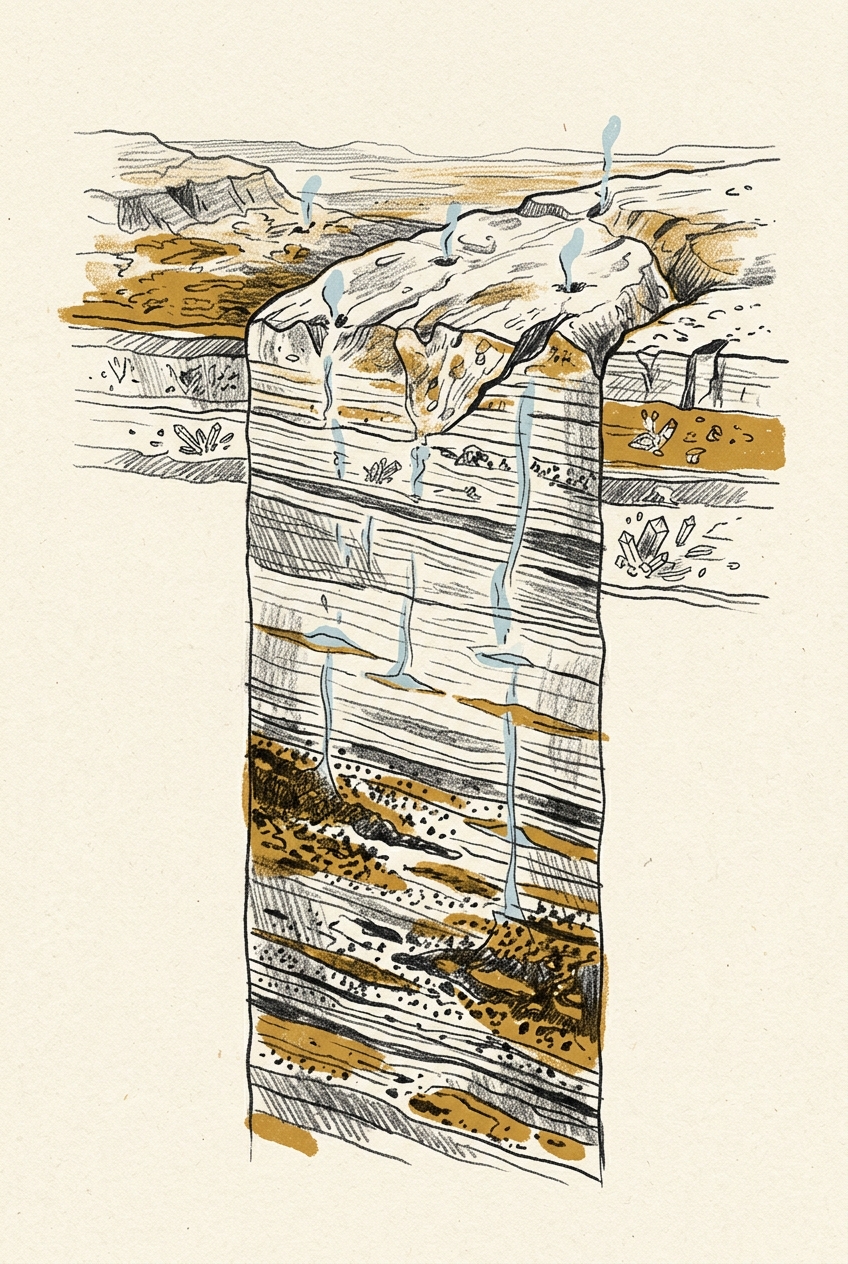
The basin is not sealed. Faults and joints cut through the Barney Creek Shale, providing pathways for gas to migrate upward. Some of this gas reaches the surface, where it oxidises to carbon dioxide or escapes into the atmosphere. Drilling in the 1980s and 1990s encountered methane shows in exploration wells, but the flow rates were too low and the permeability too poor for economic extraction.
Yet the gas is still being generated. The organic matter in the Barney Creek Shale has not fully matured. Given enough time—another hundred million years or so—it might generate more. The basin is a slow reactor, running on geological timescales. The methane that seeps today is not a remnant of a single event but the product of a continuous, sluggish process that has been operating since the Mesoproterozoic.
What the Gas Tells Us
The McArthur Basin gas is a window into the early Earth. It shows that microbial methane production was active in Proterozoic seas, and that some of that methane was trapped and preserved in the sedimentary record. It also helps explain the carbon isotope signatures found in ancient rocks, which have long puzzled geologists trying to reconstruct the early carbon cycle.
Modern methane seeps in the basin support microbial communities that live on the gas, including methanotrophic bacteria that oxidise the methane before it reaches the atmosphere. These living communities mirror the ancient ones that first produced the gas. The system has not changed in its essentials for more than a billion years: microbes make methane, other microbes eat it, and the rock records the transaction.
The McArthur Basin is not spectacular. It has no towering cliffs, no gemstones, no dinosaur bones. It is flat, dry, and sparsely vegetated. But beneath the surface, the Proterozoic sea still breathes—slowly, quietly, and with a patience that only stone can hold.
More like this
- The 1.2-Billion-Year-Old Lake That Still Burns UndergroundIn the Stuart Shelf, 1.2-billion-year-old sedimentary rocks contain the world's oldest preserved groundwater, still chemically active and capable of generating hydrogen from radioactive decay.
- The 1.1-Billion-Year-Old Salt That Collapsed a ContinentIn the Amadeus Basin, 1.1-billion-year-old evaporite beds dissolved beneath Central Australia, triggering the collapse that formed the MacDonnell Ranges and opened pathways for mineral deposits.
- The 585-Million-Year-Old Embryos That Refuse to DecayIn the Ediacaran hills of South Australia, 585-million-year-old fossils preserve the earliest known animal embryos, their cells still visible in phosphate.