11 July 2026 · 2 min read
The 180-Million-Year-Old Organ That Still Plays in the Stone
Tasmania's Organ Pipes are 180-million-year-old dolerite columns formed when Gondwana began to rift, now exposed as the frozen skeleton of a lost magma chamber.
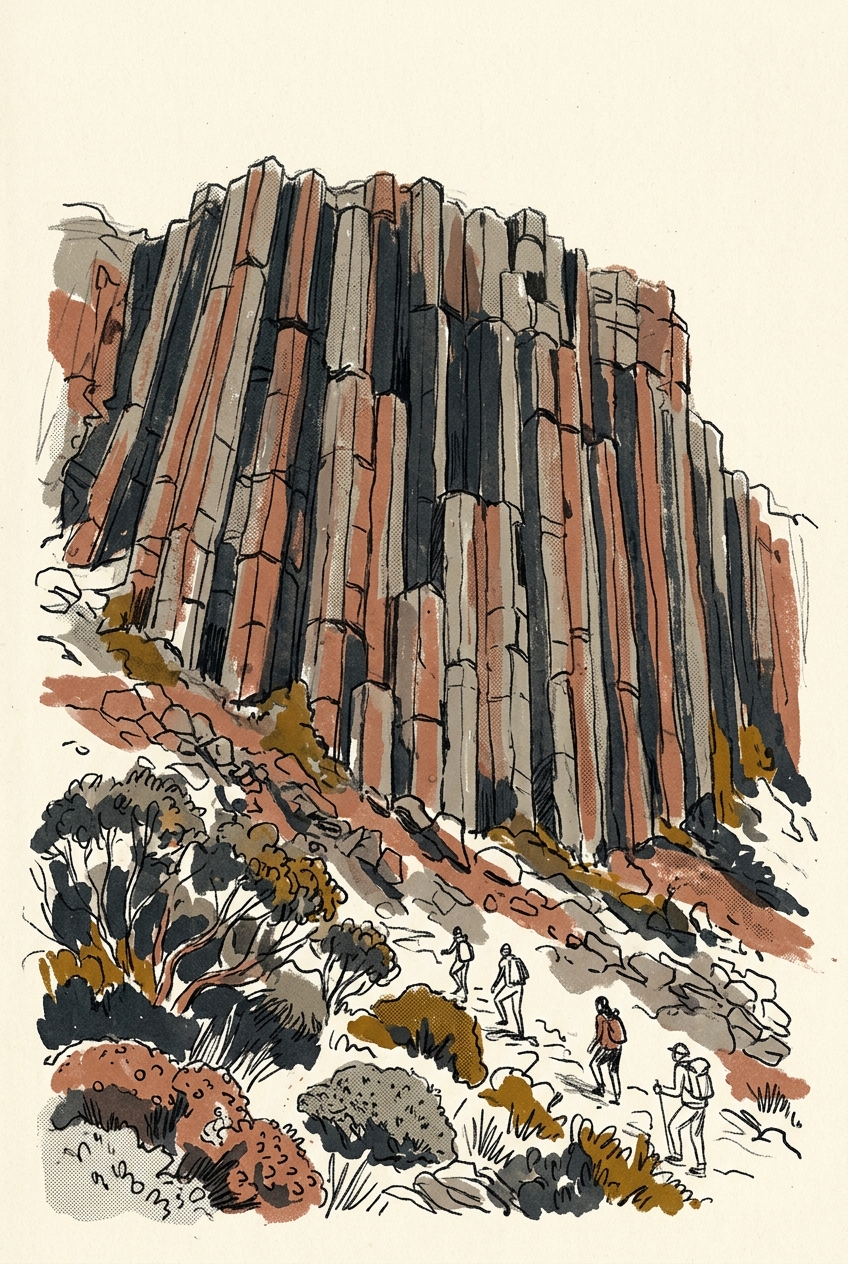
The tallest living thing in Australia was not a mountain, but a tree. In a deep valley of the Central Plateau, the dolerite columns of Tasmania's Organ Pipes rise 80 metres straight out of the earth—a frozen organ whose notes were set 180 million years ago, when Gondwana began to tear apart.
The Great Crack
When Gondwana started to rift in the Jurassic, enormous volumes of magma pushed up through Tasmania's crust but never reached the surface. It cooled slowly underground, contracting into perfect hexagonal columns as it shrank. This is the Ross Orogeny's aftermath, exposed by 180 million years of erosion.
The columns are dolerite, a dark, heavy rock chemically identical to basalt but crystallised at depth. As the magma cooled, it cracked along predictable planes—shrinkage fractures that formed six-sided pillars, each one a record of the even, slow cooling that only a massive intrusion can produce.
Mount Wellington, standing 1,271 metres above Hobart, is capped by these columns. Its summit is a platform of broken hexagons, scattered with cushion plants and the skeletons of snow gums.
The Frozen Plumbing
Dolerite covers roughly a third of Tasmania's surface, making it one of the largest exposures of this rock type on Earth. The columns are most dramatic at the Organ Pipes on Mount Wellington, where a cliff of vertical columns resembles the pipes of a church organ.
The columns are not decoration. They are the exposed skeleton of a magma chamber that once fed a chain of volcanoes now completely eroded away.
Each column is typically 1–2 metres across. The fracture patterns reveal the cooling history: slower cooling produces wider columns, while faster cooling yields narrower, more irregular shapes. Some columns are curved, bent by the flow of still-molten rock deeper in the chamber.
The Legacy of a Breakup
What makes Tasmania's dolerite remarkable is not its size but its context. This is a Jurassic large igneous province, emplaced during the initial breakup of Gondwana around 180 million years ago. The same event produced dolerite sills in South Africa, Antarctica, and South America—fragments of a single magma pulse that once stretched across the supercontinent.
In Tasmania, the dolerite resisted erosion while the softer sedimentary rocks around it wore away. The result is a plateau landscape of striking flatness: the Central Plateau, a 1,000-metre-high tableland of dolerite that holds thousands of freshwater lakes in its frost-shattered hollows.
The columns continue to crack. Frost wedging splits the hexagons along their natural joints, producing talus slopes of dolerite boulders at the base of every cliff. The Organ Pipes are slowly disassembling themselves, one winter freeze at a time.
More like this
- The 1.6-Billion-Year-Old Pillows That Still Rest on the SeafloorIn the McArthur Basin, 1.6-billion-year-old pillow basalts preserve the shape and chemistry of lava that erupted into a Proterozoic sea, recording the oxygen-poor ocean where the pillows still rest.
- The 1.7-Billion-Year-Old Sill That Holds Sapphires in PlaceIn the Kimberley, 1.7-billion-year-old dolerite sills host sapphires that crystallised directly in volcanic fractures—a rare type of deposit formed in place, not washed into riverbeds.
- The 1.1-Billion-Year-Old Sea That Left a Purple BedIn the Amadeus Basin, a 1.1-billion-year-old salt lake deposited the Gillen Formation—a purple evaporite bed that still shapes Central Australian geology and water chemistry today.