11 July 2026 · 3 min read
The 1.6-Billion-Year-Old Pillows That Still Rest on the Seafloor
In the McArthur Basin, 1.6-billion-year-old pillow basalts preserve the shape and chemistry of lava that erupted into a Proterozoic sea, recording the oxygen-poor ocean where the pillows still rest.
The 1.6-billion-year-old lava did not spill across the land. It erupted under water, in a sea that no longer exists, and it cooled into a field of pillows that still hold the shape of the moment they froze.
The Pillow Basalts of the McArthur Basin
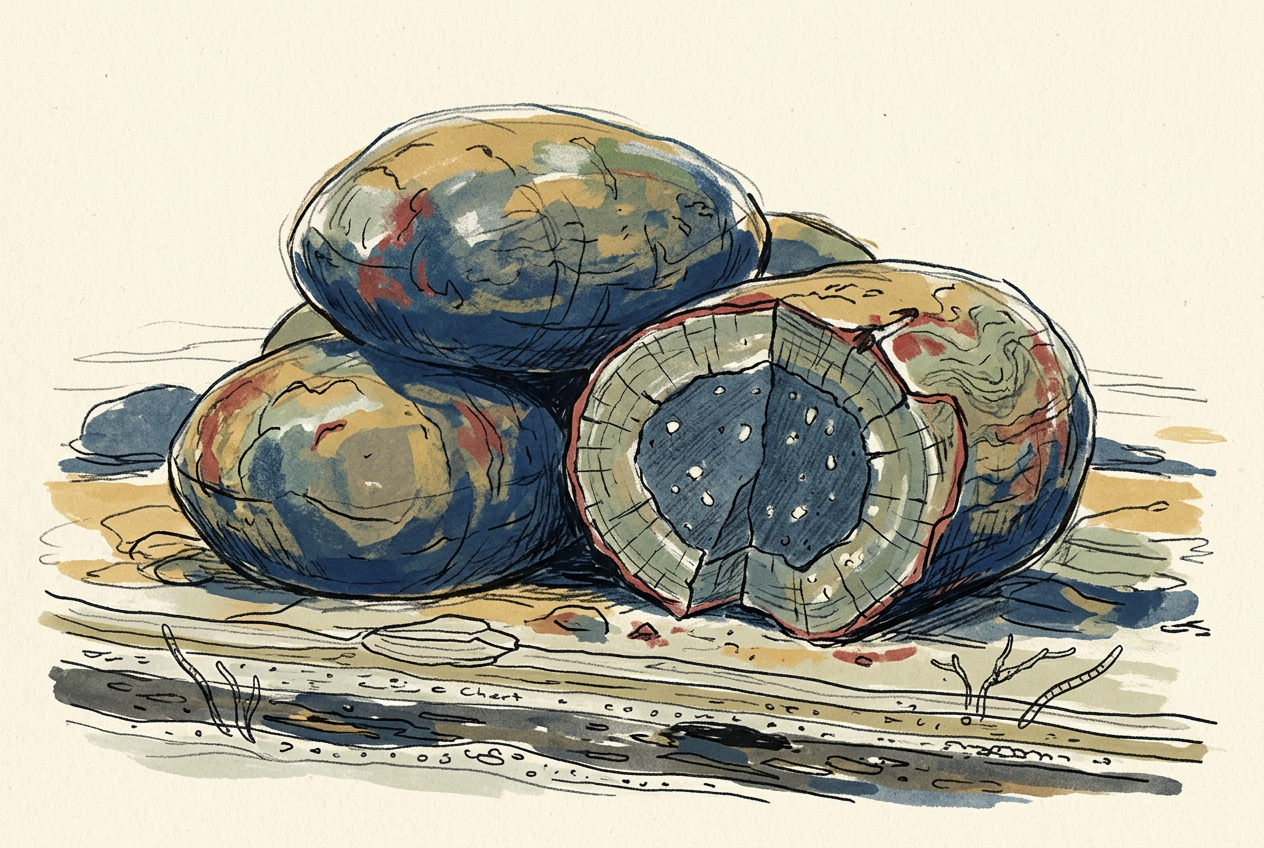
In the McArthur Basin of northern Australia, near the Gulf of Carpentaria, cliffs of dark volcanic rock preserve one of the most expressive textures in geology: pillow basalt. These are not metaphors. The rock formed in rounded, bulbous lobes, each one a few feet across, stacked and nested like a cargo of giant cushions. The pillows formed when molten basalt erupted into water and chilled instantly, skinning each lobe in glass while the interior continued to flow and inflate.
The water was the McArthur Sea, a shallow basin that existed 1.6 billion years ago, during the Paleoproterozoic. The region was then part of a larger system of rifting and sedimentation that stretched across northern Australia. The pillows are interbedded with black shales, dolomites, and tuff layers—evidence of a dynamic seafloor where volcanism and sediment accumulated in alternating pulses.
What the Pillows Preserve
Pillow basalts are rare in rocks older than a billion years. Most have been metamorphosed, sheared, or dissolved. But in the McArthur Basin, the pillows remain remarkably intact. Their glassy rims have been replaced by silica and chlorite, but the original shapes are unmistakable: radial cooling joints, curved upper surfaces, and the characteristic convex-downward bases where one pillow settled against another.
Geologists use these pillows as way-up indicators—they tell you which side of the rock was originally the top. The pillows bulge upward; the spaces between them fill with sediment from above. In the McArthur Basin, the pillows also record the chemistry of the ancient water. The alteration minerals in the glassy selvages contain traces of seawater-derived elements, preserving a chemical fingerprint of the Proterozoic ocean.
A World Without Oxygen
The McArthur Basin pillows erupted into a world radically different from our own. The atmosphere contained less than one percent of today's oxygen. The sea was rich in dissolved iron and silica but poor in sulfate. The pillows interacted with that water, exchanging magnesium, calcium, and potassium, and the alteration products locked in a record of that chemistry.
The pillows are time capsules of a sea that breathed iron instead of oxygen.
This matters because pillow basalts are among the most common rocks on the seafloor of the early Earth. They may have provided the chemical gradients necessary for the origin of life—warm, alkaline fluids circulating through fractured glass, reacting with seawater to produce hydrogen and organic molecules. The McArthur pillows are not the oldest known—the Pilbara's 3.5-billion-year-old pillows hold that title—but they are among the best preserved for their age.
The Shape of a Planet's Youth
Walk along the base of a McArthur Basin cliff and you can trace the contours of individual pillows, each one a frozen bubble of magma that never reached the surface. The rock is dark green-grey, fine-grained, sometimes spotted with white calcite veins that filled cracks after the pillows had cooled. The pillows are exposed in cross-section along creek beds and road cuts, their rounded profiles stacked like a pile of melons.
To touch them is to touch the surface of a 1.6-billion-year-old lava flow that never saw the sky. The pillows were born in darkness, under the weight of an ancient sea, and they remain exactly where they formed. They are not dramatic like the Organ Pipes or colorful like the banded iron formations. They are quiet, dense, and easily overlooked. But they preserve something essential: the way the young Earth built its crust, one pillow at a time, under water, in the dark.
More like this
- The 180-Million-Year-Old Organ That Still Plays in the StoneTasmania's Organ Pipes are 180-million-year-old dolerite columns formed when Gondwana began to rift, now exposed as the frozen skeleton of a lost magma chamber.
- The 1.7-Billion-Year-Old Sill That Holds Sapphires in PlaceIn the Kimberley, 1.7-billion-year-old dolerite sills host sapphires that crystallised directly in volcanic fractures—a rare type of deposit formed in place, not washed into riverbeds.
- The 1.1-Billion-Year-Old Sea That Left a Purple BedIn the Amadeus Basin, a 1.1-billion-year-old salt lake deposited the Gillen Formation—a purple evaporite bed that still shapes Central Australian geology and water chemistry today.