13 July 2026 · 3 min read
The 585-Million-Year-Old Embryos That Refuse to Decay
In the Ediacaran hills of South Australia, 585-million-year-old fossils preserve the earliest known animal embryos, their cells still visible in phosphate.
In South Australia's Flinders Ranges, a hill of grey limestone holds the oldest embryos on Earth. They are smaller than a grain of sand, and they died half a billion years before the first dinosaur hatched.
The Phosphatic Window
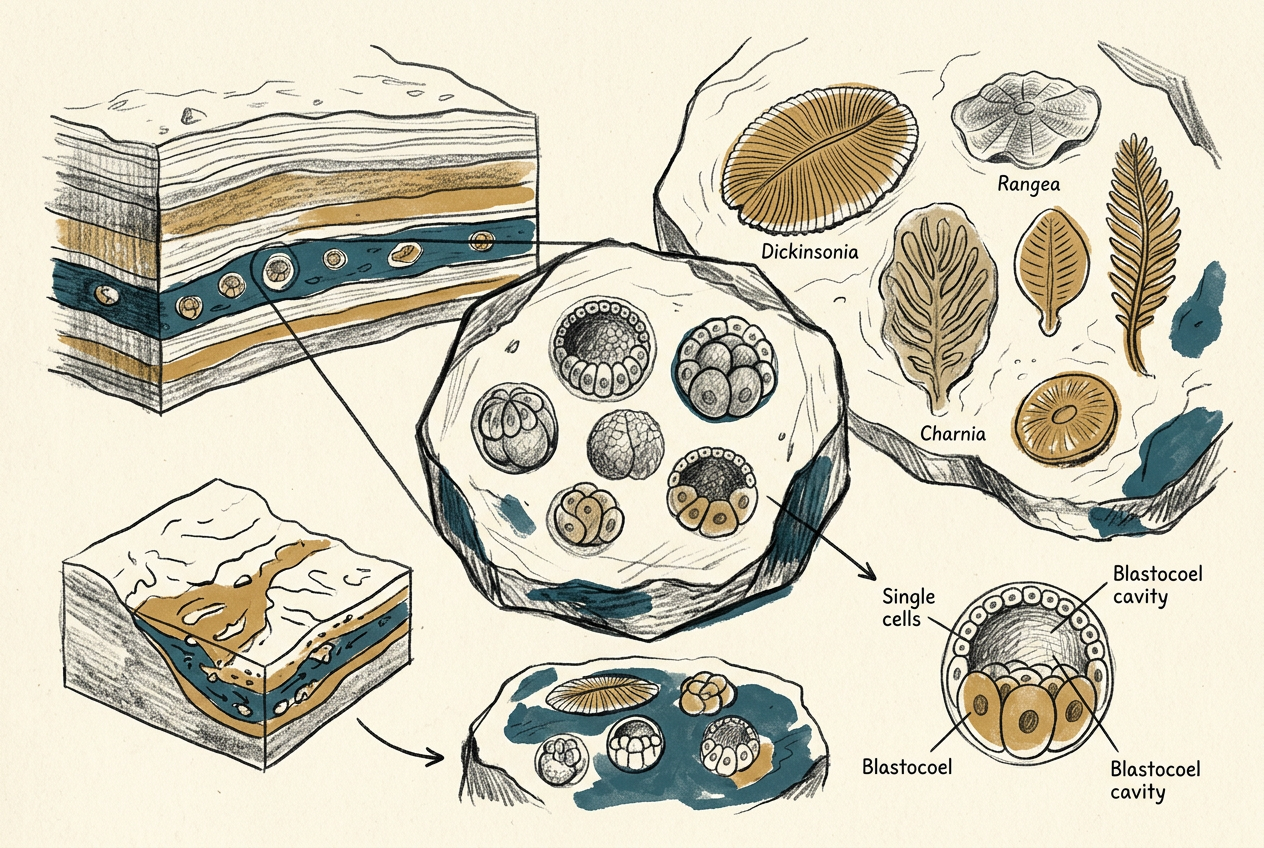
The Doushantuo Formation in China has long held the title for the oldest animal embryos, but South Australia's Wonoka Formation runs close — and tells a different story. At a site near the Brachina Gorge, 585-million-year-old phosphatic nodules preserve clusters of cells so finely that individual nuclei are still visible under a microscope. These are not bones or shells; no hard parts had evolved yet. What preserved them was phosphate.
Phosphate can replace soft tissue cell by cell, locking organic structure in stone before decay sets in. The Wonoka embryos caught this transition mid-process. Some specimens show cells in the act of dividing, caught at the two-cell, four-cell, and sixteen-cell stages — a freeze-frame of development that lasted 585 million years.
A World Without Predators
These embryos lived in a sea that would be unrecognisable to us. The seafloor was covered in microbial mats, a living skin that stabilised sediment and prevented the churning that burrowing animals later introduced. Nothing on the Ediacaran seafloor could dig. Nothing could chew. The water column held plankton, but the first active predators had not yet evolved.
In such a world, being small was not a disadvantage. The embryos belonged to an organism that likely floated or drifted, releasing its young into the water column where they sank into the phosphate-rich muds below. The chemical conditions that enabled this preservation — high phosphate, low oxygen, rapid burial — would not recur on the same scale until much later in Earth history.
The cells stopped dividing while the Ediacaran world was still young, and phosphate sealed them as they fell.
What the Cells Reveal
The Wonoka embryos are controversial. Some researchers argue they are not embryos at all, but giant bacteria or even artefacts of mineral growth. The debate turns on a few micrometres: true embryos show a regular pattern of cell division called palintomy, where each division reduces cell size while keeping the overall volume constant. Bacteria do not divide this way. The Wonoka specimens show palintomic division, with cell sizes that shrink predictably from the two-cell to the multicellular stage.
If they are embryos, they push the origin of complex multicellular life deeper into the Ediacaran, before the famous fronds and discs of the Flinders Ranges. They also suggest that sexual reproduction — with its vulnerable early developmental stages — was already established in the Ediacaran seas, half a billion years before the Cambrian explosion made skeletons fashionable.
The Preservation Lottery
Phosphatic preservation on this scale is rare. It requires seawater enriched in phosphate, rapid burial in anoxic sediment, and a chemical microenvironment that prevents dissolution. The Wonoka Formation hit all these conditions, but only in scattered nodules. Most Ediacaran embryos decayed without a trace, their cells collapsing into the mud within hours of death.
The nodules that survived were found by geologists mapping the Brachina Gorge area in the 1990s. They were not looking for embryos. They were studying the sedimentary layers of the Adelaide Rift Complex, a failed rift basin that accumulated sediment for hundreds of millions of years. The same basin later preserved the Ediacaran fronds at Nilpena and the trace fossils of the earliest walking animals. The Wonoka Formation sits below those famous beds, a deeper and older archive of a world that left almost nothing behind.
A single phosphate nodule, split open in a laboratory, can hold a dozen embryos at different stages of development. Each one is a roll of film from a camera that stopped clicking before the first trilobite appeared.
More like this
- The 270-Million-Year-Old Earthquakes Frozen in SandstoneAlong the New South Wales coast, 270-million-year-old sandstones preserve the record of ancient earthquakes that turned the seafloor to liquid.
- The 340-Million-Year-Old Reef That Slid Off a CliffIn the Kimberley, a 340-million-year-old reef slid intact off a cliff, preserving an entire Carboniferous coral ecosystem as a single rotated slab.
- The 124,000-Year-Old Forest That Now Grows Under the Sea124,000-year-old trees still standing upright on the seafloor of Spencer Gulf record a warmer world and the pace of ancient sea-level rise.