12 July 2026 · 3 min read
The 340-Million-Year-Old Reef That Slid Off a Cliff
In the Kimberley, a 340-million-year-old reef slid intact off a cliff, preserving an entire Carboniferous coral ecosystem as a single rotated slab.
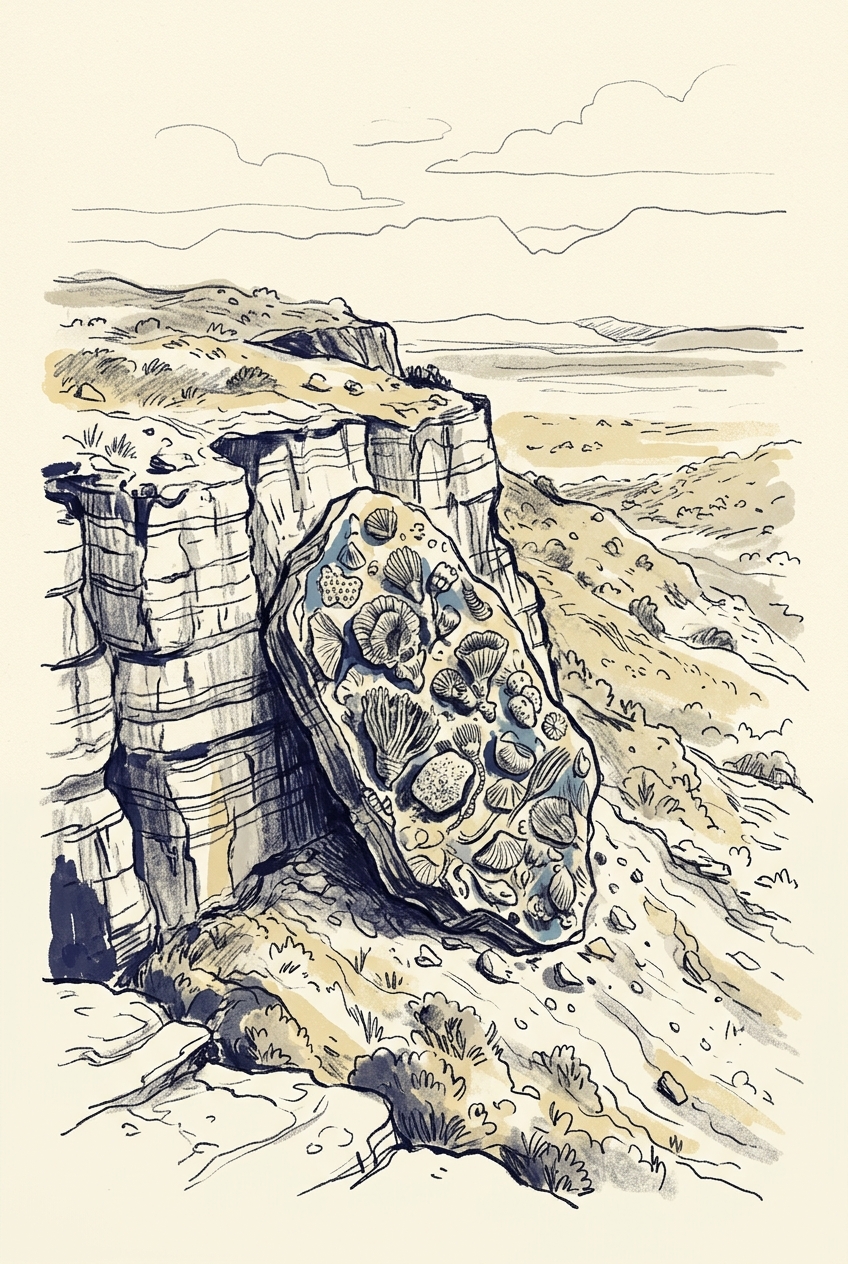
A slab of limestone the size of a football field once slid sideways off a cliff in the Kimberley, carrying a 340-million-year-old reef with it. The rock landed upright, tilted but intact, and now stands as one of the best-preserved Carboniferous coral reefs on Earth.
The Reef That Traveled
The Napier Range is a Devonian-to-Carboniferous limestone belt that runs for hundreds of kilometres along the southern edge of the Kimberley plateau. It was once the margin of a shallow tropical sea that covered much of northern Australia. Within that limestone, a single enormous block — the Horse Spring Reef — detached from the cliff face and slid downslope as a coherent slab, rotating nearly 90 degrees as it fell. The movement happened along a bedding plane lubricated by groundwater, a process geologists call a block glide. When it stopped, the reef face was exposed in cross-section, as cleanly as a core sample pulled from a drill rig.
A Carboniferous Menagerie
The exposed surface reveals the internal structure of a reef that grew between 340 and 330 million years ago, during the early Carboniferous. Rugose corals — solitary, horn-shaped animals — stand upright in growth position, their calices still filled with the fine sediment that smothered them. Colonial tabulate corals spread in layered sheets. Bryozoans encrusted the dead surfaces, and crinoid stems littered the seafloor like stacked coins. The reef was built not by modern stony corals but by a consortium of organisms that no longer dominate reef ecosystems. The block glide preserved their spatial relationships exactly as they were in life: which species grew on which, which competed for space, which colonised the rubble after storms.
The rock does not merely contain fossils. It contains a frozen map of ecological relationships.
A Window Into the Carboniferous World
During the early Carboniferous, Australia sat near the equator, its northern margin bathed in warm, clear water. The Napier reef system flourished along a continental shelf that sloped into deep water. The Horse Spring block records a reef-front environment — the steep, wave-swept face where coral growth was most vigorous and where the energy of the open ocean sorted sediment into coarse debris aprons at the base. The block glide preserved this gradient in a single vertical slab: the reef crest at the top, the fore-reef slope below, and the talus pile at the bottom. Geologists can walk along the exposed face and trace the transition from living reef to rubble in a few dozen paces.
The Carboniferous was also a time of fluctuating sea levels, driven by the growth and retreat of ice sheets on the southern supercontinent Gondwana. The Horse Spring reef records at least one such event. A layer of black, organic-rich shale caps the reef, deposited when rising waters drowned the corals and cut off oxygen at the seafloor. The reef stopped growing, but the block that preserved it kept its shape.
Why It Matters
Most ancient reefs are studied in scattered outcrops or drill cores, their original geometry obscured by deformation and erosion. The Horse Spring reef is different. Because the entire block rotated as a single unit, the spatial relationships between organisms are preserved at the scale of a whole ecosystem. It is a rare example of a fossil reef that can be read like a museum diorama. It also serves as a reminder that the Kimberley landscape is not simply old — it is mobile. The same groundwater that dissolved the limestone into caves and gorges also lubricated the slide that carried this reef into view. The rock moved, and in moving, it revealed what was inside.
More like this
- The 124,000-Year-Old Forest That Now Grows Under the Sea124,000-year-old trees still standing upright on the seafloor of Spencer Gulf record a warmer world and the pace of ancient sea-level rise.
- The 4.5-Million-Year-Old Volcanoes That Never Saw the SkyAustralia's flat-topped tuyas preserve the rare record of volcanoes that erupted beneath Pliocene glaciers, their basalt caps now standing as the oldest known examples of ice-confined eruptions on Ear
- The 1.2-Billion-Year-Old Seabed That Still Holds a Frozen TsunamiIn the Kimberley's Bungle Bungle Range, a 1.2-billion-year-old turbidite bed preserves the exact moment a submarine avalanche swept across an ancient seafloor, now frozen in sandstone.