17 May 2026 · 4 min read
The Volcano That Gave Birth to Australia's Largest Copper Mine: South Australia's Olympic Dam
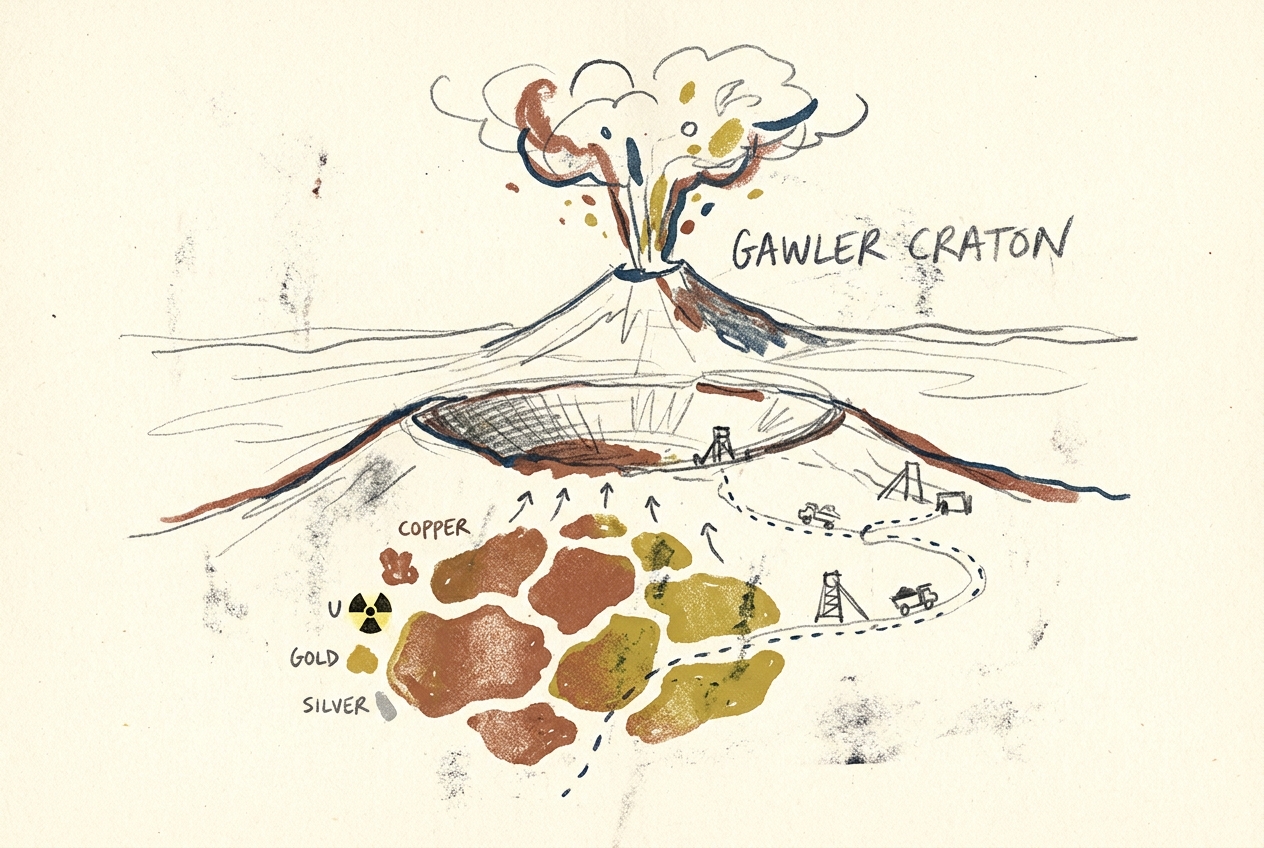
How a 1.6-billion-year-old volcanic caldera in South Australia's Gawler Craton concentrated copper, uranium, gold, and silver into the world's largest known uranium deposit and fourth-largest copper d
Beneath the flat red plains of South Australia's far north, 550 kilometres from Adelaide, lies a geological freak: a single ore body that holds more uranium than any other known deposit on Earth, 10 million tonnes of copper, and enough gold and silver to make it one of the most valuable pieces of ground ever discovered.
This is Olympic Dam, and it should not exist.
A Volcano That Collapsed
The story begins 1.6 billion years ago, in the Proterozoic. The Gawler Craton — the ancient core of southern Australia — was being stretched and pulled apart by tectonic forces. Molten granite rose from the mantle and pooled in a chamber a few kilometres beneath the surface. As pressure built, the roof above the chamber fractured, and a series of violent eruptions sent ash and rock across the landscape.
But then something unusual happened. The magma chamber emptied, and the ground above it collapsed inward, forming a depression called a caldera — a circular basin roughly five kilometres across. This was not a simple crater. The collapse created a ring of fractures around the caldera's margin, like cracks around a sagging pie crust. Those fractures would become the plumbing system for one of the world's great ore deposits.
For millions of years after the caldera collapsed, hot fluids circulated through the broken rock, leaching metals from the granite and depositing them in the fracture zones.
The Recipe for a Supergiant
Olympic Dam is what geologists call an iron-oxide-copper-gold (IOCG) deposit, a class of ore body that was not recognised as a distinct type until the 1970s. The key ingredient is hematite — iron oxide — which makes up more than half the rock. The hematite acted as a chemical sponge, pulling copper, uranium, gold, and silver out of the circulating hydrothermal fluids and locking them into the rock.
The deposit formed in three main stages. First, the volcanic eruptions and caldera collapse created the structural trap — the ring fractures that allowed fluids to move through the rock. Second, the hematite-rich fluids deposited iron oxide in the fracture zones, along with minor amounts of copper and uranium. Third, a later pulse of hydrothermal activity, possibly related to a separate event tens of millions of years after the caldera formed, introduced the main copper and uranium mineralisation.
The result is a deposit that defies easy categorisation. Olympic Dam contains copper, uranium, gold, and silver in a single ore body, but the metals are not evenly distributed. The copper-rich zones are separate from the uranium-rich zones, and the gold tends to follow the copper. This complexity made the deposit difficult to find and even harder to understand.
Discovery by Accident
Olympic Dam was discovered in 1975 by Western Mining Corporation, a company that was actually searching for copper deposits similar to those found at Mount Isa in Queensland. The exploration team used a combination of geophysical surveys and drilling to test a buried magnetic anomaly — a slight variation in the Earth's magnetic field that suggested iron-rich rocks beneath the surface.
The first drill hole intersected 35 metres of copper mineralisation at a depth of 350 metres. It was not until the fifth drill hole, however, that the true scale of the deposit became clear. That hole intersected 170 metres of continuous copper-uranium mineralisation — a result that prompted the chief geologist to describe the discovery as "once in a lifetime."
The deposit lies buried beneath 300 metres of flat-lying sedimentary rocks — younger sandstones and shales that were deposited long after the caldera had formed and been eroded flat. Nothing on the surface gives any hint of what lies below. The ore body is completely blind, invisible to any technique except geophysics and drilling.
A Window into Proterozoic Processes
Olympic Dam is not unique — similar deposits have since been found in Chile, Brazil, and China — but it remains the largest and richest example of its kind. The deposit preserves a record of Proterozoic volcanic and hydrothermal processes that are poorly understood elsewhere.
The Gawler Craton was a remarkably active place 1.6 billion years ago. Multiple episodes of volcanism and plutonism occurred across the region, each one potentially capable of forming ore deposits. Olympic Dam is the largest, but there are dozens of similar — though smaller — deposits scattered across the craton, many still unexplored.
The deposit also poses a puzzle. The uranium at Olympic Dam is unusually rich in the isotope uranium-235, the fissile variety used in nuclear reactors and weapons. This isotopic anomaly suggests that the uranium was derived from a source that had not undergone extensive previous melting — perhaps a deep, primitive part of the Earth's crust that had remained undisturbed for billions of years.
The Scale of What Remains
Mining at Olympic Dam began in 1988. The operation is now a massive underground mine, extending more than a kilometre beneath the surface. The ore body is still open at depth — drilling has intersected mineralisation as deep as 2.5 kilometres, and the deposit may extend much further.
The total resource is estimated at 8 billion tonnes of ore, containing 60 million tonnes of copper, 2 million tonnes of uranium oxide, and significant quantities of gold and silver. At current extraction rates, the mine has a life of several hundred years. The deposit is so large that only a fraction of it has been drilled in detail.
Olympic Dam is a reminder that the most valuable geological features are often invisible. A collapsed volcano, buried beneath flat ground, holds resources that would have been unimaginable to the Proterozoic world that created them.
More like this
- The 5,000-Year-Old Volcanoes That Still Smoke in the SouthIn Victoria's Newer Volcanics Province, 400 volcanic vents erupted as recently as 5,000 years ago—the youngest volcanic field in mainland Australia, where craters still hold blue lakes and scoria cone
- The 300-Million-Year-Old Forest That Died Standing UpIn New South Wales, a 300-million-year-old fossil forest preserves dozens of trees buried upright by a Permian volcanic eruption—an entire ecosystem frozen in ash.
- The 1.85-Billion-Year-Old Caldera That Still Feeds the FurnaceIn South Australia's Middleback Ranges, a 1.85-billion-year-old volcanic caldera collapsed and later became one of the world's richest iron ore deposits.