17 May 2026 · 4 min read
The Lava That Drew a Map of Evolution: Victoria's Devonian Fish Beds
How 380-million-year-old volcanic ash beds in Victoria's Givetian fish beds preserved a snapshot of Devonian marine life, including the world's oldest known lungfish.
Near the small Victorian town of Coopers Creek, a roadside cutting exposes a layer of grey mudstone no thicker than a paving slab. Split it open with a hammer, and you might find the skull of a fish that breathed air 380 million years ago—preserved not by slow burial, but by a sudden rain of volcanic ash.
The Ash That Froze Time
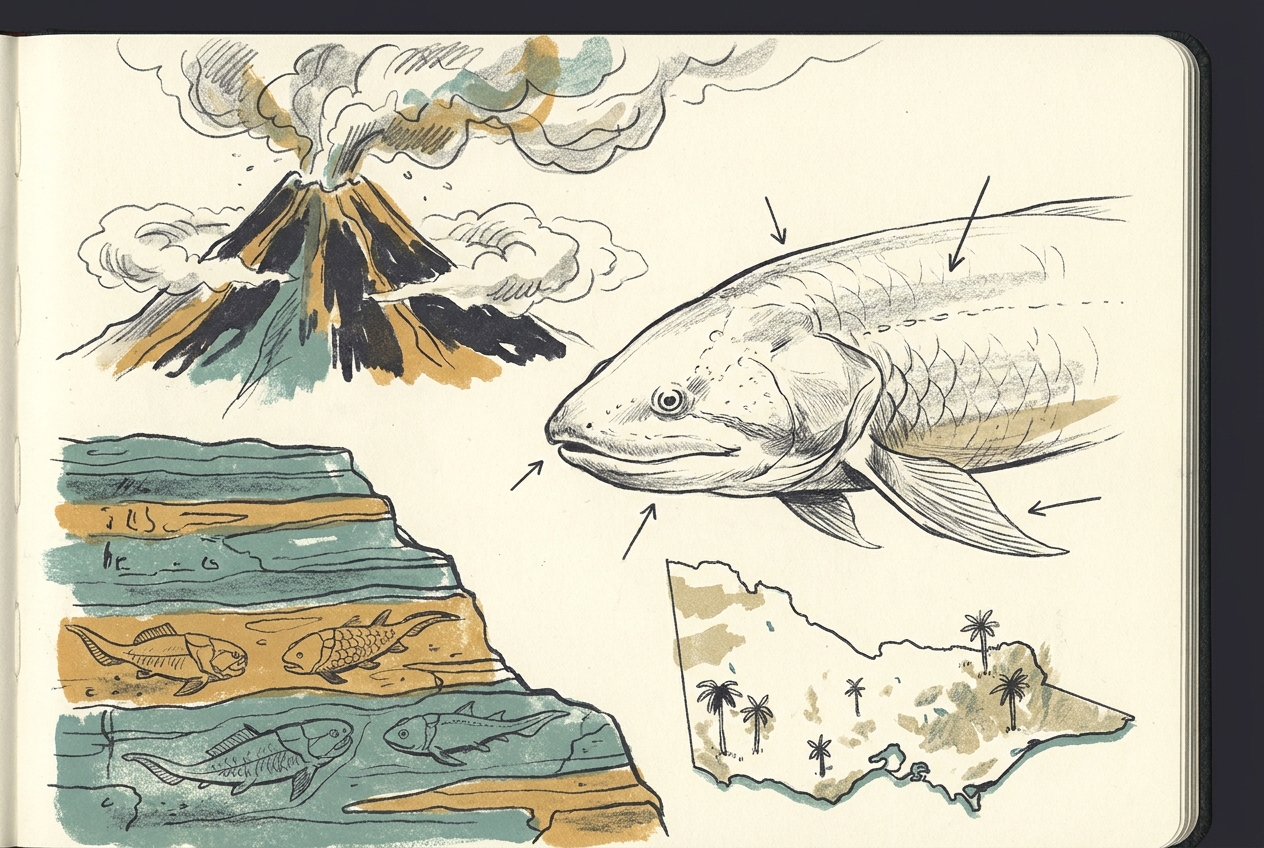
In the Middle Devonian, roughly 385 to 375 million years ago, eastern Victoria lay beneath a shallow sea. The coastline was dotted with volcanic arcs—the remnants of a subduction zone that would eventually help assemble the supercontinent Gondwana. Volcanoes erupted regularly, and each eruption sent fine ash drifting across the water.
That ash settled slowly through the water column, like a gentle snowfall. On the sea floor, it smothered whatever lay there. For fish that died near the vents, the process was fast enough to preserve soft tissues and delicate bone structures that normal sedimentation would have crushed or scattered.
The result is the Givetian fish fauna of the Snowy River Volcanics—a series of fossil beds that contain some of the best-preserved Devonian fish in the world. The rocks are exposed in road cuttings, creek beds, and quarry faces across eastern Victoria, from Buchan to Bairnsdale.
A Lungfish That Changed History
The most famous fossil from these beds is Dipnorhynchus sussmilchi, a lungfish that lived in the warm Devonian seas. Its skull, discovered near Coopers Creek in the 1970s, is the oldest known lungfish specimen in the world.
Lungfish are significant because they sit on the evolutionary branch that leads to tetrapods—the first vertebrates to walk on land. The Coopers Creek specimen preserves details of the braincase and palate that help paleontologists understand how fish began to develop the structures needed for breathing air and supporting weight on land.
But the Givetian beds contain more than lungfish. Paleontologists have also found placoderms—armoured fish with bony plates instead of scales—and early ray-finned fish. Some specimens still show the scales and fin rays in place, a level of preservation rarely seen in rocks of this age.
The ash that killed them became the ash that kept them. In the Snowy River Volcanics, death by volcanic winter became a permanent archive.
The Volcano That Built a Museum
The volcanic rocks that preserve these fossils belong to a formation called the Snowy River Volcanics, a thick sequence of lava flows, ash falls, and volcanic sediments that accumulated in a rift basin during the Devonian. The basin formed as the crust stretched and thinned, creating a landscape of fissures, vents, and shallow seas.
The fossils occur in discrete layers within the volcanic sequence—each layer representing a single ash fall event. Some layers are only a few centimetres thick; others reach a metre or more. They are sandwiched between lava flows that protected them from erosion.
Geologists have dated these ash beds using zircon crystals from the volcanic rock itself. The dates are precise: 380 million years, give or take a few hundred thousand. That precision is rare in Devonian fossil sites, which are usually dated by the fossils themselves, not by the rock they sit in.
What the Fish Reveal
The Givetian fish beds tell a story about the Devonian world that goes beyond the fossils themselves. The ash layers allow geologists to correlate rock units across hundreds of kilometres, building a timeline of volcanic activity, sea-level change, and climate.
They also reveal something about the evolution of life. The Devonian is called the Age of Fishes for good reason: it was the period when fish diversified into the major groups that still dominate the oceans today. The Victorian beds capture a moment in that diversification, preserved with a clarity that rivals the better-known Devonian sites in Scotland and Germany.
But unlike those sites, the Victorian beds are tied directly to volcanic events. The ash that preserved the fish also records the tectonic forces that shaped eastern Australia. The same subduction zone that fed those volcanoes would later drive the formation of the Lachlan Fold Belt, the mountain range that became the Great Dividing Range.
A Quiet Archive
The Coopers Creek cutting is not a tourist attraction. There is no visitor centre, no interpretive sign, no car park. It is a muddy bank on a back road, where the only sound is the occasional truck and the tap of a geologist's hammer.
But inside that mudstone are the remains of animals that lived when the world was one continent, when fish were experimenting with breathing air, and when volcanoes rained ash into a warm sea. The ash that killed them became the ash that kept them—a quiet archive of a world that died to make ours possible.
More like this
- The 5,000-Year-Old Volcanoes That Still Smoke in the SouthIn Victoria's Newer Volcanics Province, 400 volcanic vents erupted as recently as 5,000 years ago—the youngest volcanic field in mainland Australia, where craters still hold blue lakes and scoria cone
- The 560-Million-Year-Old Garden That Never Saw a PredatorIn South Australia's Flinders Ranges, 560-million-year-old Ediacara surfaces preserve entire seafloor communities of fronds, discs, and quilts — a garden of soft-bodied life that flourished before pre
- The 300-Million-Year-Old Forest That Died Standing UpIn New South Wales, a 300-million-year-old fossil forest preserves dozens of trees buried upright by a Permian volcanic eruption—an entire ecosystem frozen in ash.