17 May 2026 · 3 min read
The Reef That Animals Built: South Australia's Ediacaran Fossil Coast
In the Flinders Ranges, 555-million-year-old fossilised seafloor shows that Ediacaran organisms built wave-resistant reef structures 200 million years before corals—changing how we understand early an
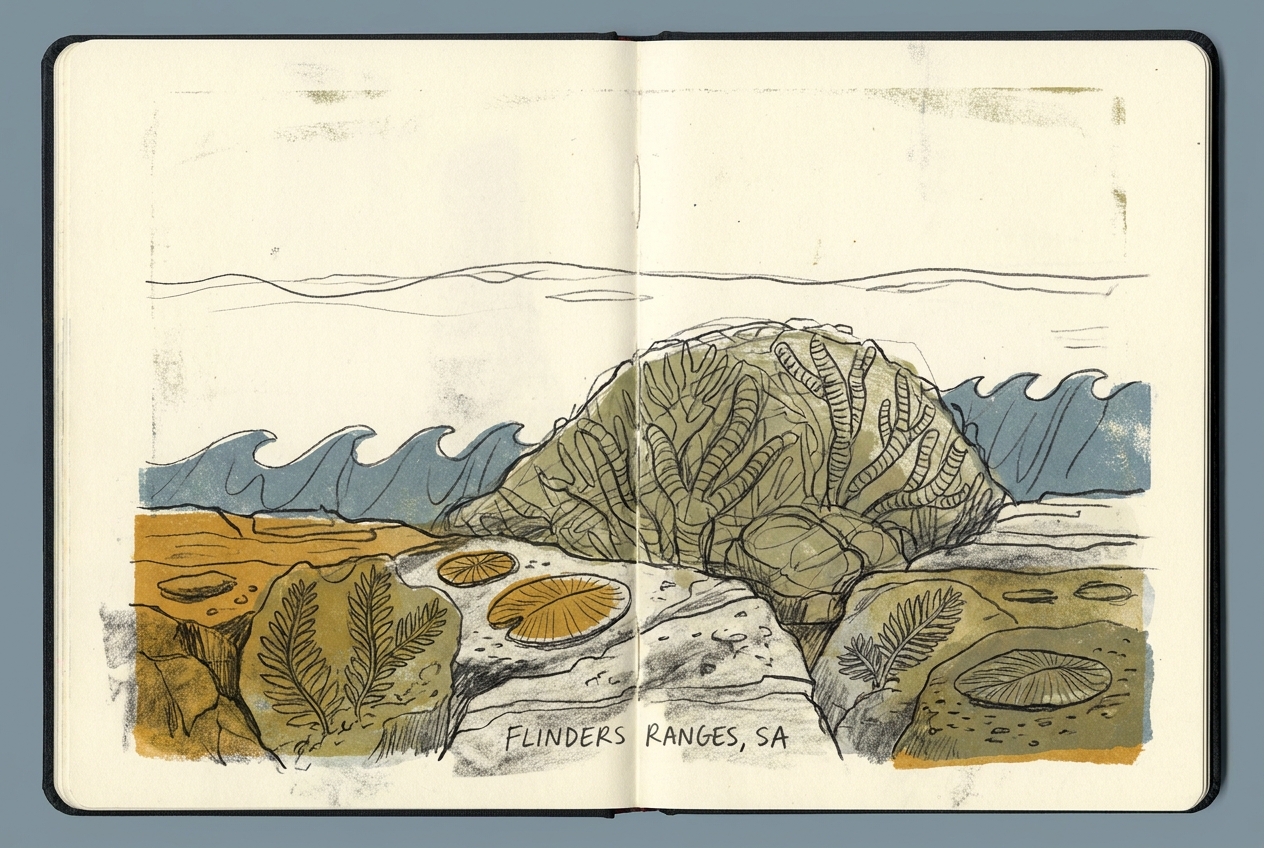
The seafloor near Beltana Station in South Australia's Flinders Ranges is covered in what look like fossilised cabbage leaves, each one the cast of a creature that died 555 million years ago. These are not plants. They are Dickinsonia—animals up to a metre long that grew by adding segments to their bodies, the way a conveyor belt adds rollers. And they lived in communities that built structures geologists now recognise as the world's oldest animal-built reefs.
The Ediacaran Seafloor
The Flinders Ranges preserve a slice of the Ediacaran period (635 to 541 million years ago), when the first complex multicellular life appeared on Earth. The rocks here are shallow marine sediments—siltstone and sandstone laid down on a quiet seafloor that occasionally received blankets of volcanic ash.
At the Nilpena Ediacara National Park, about 450 kilometres north of Adelaide, researchers have excavated over 40 fossil beds that preserve entire seafloor communities in life position. The fossils are not bones or shells. They are impressions—casts of soft-bodied organisms preserved when volcanic ash or sand smothered them and filled the spaces they left behind.
What makes the Nilpena site extraordinary is its scale. Individual fossil beds span hundreds of square metres, preserving thousands of organisms in the positions they occupied when alive. You can see where Dickinsonia sat, where Spriggina crawled, and where Tribrachidium rested on the seafloor like a three-lobed umbrella.
The Reef Builders
The most surprising discovery at Nilpena is that some of these Ediacaran organisms built structures that geologists call "textured organic surfaces"—mats and mounds that rose above the seafloor and resisted wave energy. These are not coral reefs. They are biological pavements built by microbial mats and the animals that lived on them.
The key organism was Funisia dorothea, a tube-dwelling creature that grew in dense clusters, like modern sea pens or tube worms. Funisia constructed vertical tubes from organic material, and these tubes bound sediment together, creating rigid structures that could withstand currents. In the fossil beds, you can see Funisia colonies that cover areas the size of a dining table, their tubes preserved as raised ridges in the rock.
These are not the first reefs on Earth—microbial stromatolites built reefs for billions of years before the Ediacaran. But they are the first reefs built by animals.
Other Ediacaran organisms contributed to these structures. Palaeophragmodictya, a sponge-like animal, created fibrous mats that stabilised the seafloor. Aulozoon, a long, sinuous organism, burrowed through the sediment and helped bind it together. Together, these organisms transformed the Ediacaran seafloor from a soft, muddy plain into a structured, resilient habitat.
What the Reefs Tell Us
The Ediacaran reefs at Nilpena challenge the old view that Precambrian life was simple and passive. These organisms were not just lying on the seafloor waiting to be buried. They were actively modifying their environment—building structures, competing for space, and creating three-dimensional habitats.
The reefs also show that complex ecological interactions predate the Cambrian explosion by at least 20 million years. The Ediacaran communities at Nilpena had ecological tiers—organisms living on the surface, within the sediment, and above the seafloor. This tiering is the signature of a mature ecosystem, one where organisms have evolved to occupy different niches and exploit resources in different ways.
The fossil record at Nilpena captures this ecological complexity in extraordinary detail. One fossil bed preserves a community that was buried by a single volcanic ash fall, killing everything instantly and preserving the animals in their last living positions. You can see where a Dickinsonia was feeding, where a Spriggina was crawling, and where Funisia colonies stood upright in the current.
The Ediacaran reefs did not survive into the Cambrian. The animals that built them went extinct around 541 million years ago, replaced by the skeleton-building organisms of the Cambrian explosion. But for about 14 million years, these soft-bodied animal communities built the first reefs on Earth—structures that held the seafloor together and created the first complex animal ecosystems. Their casts remain in the Flinders Ranges, waiting for anyone who cares to look.
More like this
- The 560-Million-Year-Old Garden That Never Saw a PredatorIn South Australia's Flinders Ranges, 560-million-year-old Ediacara surfaces preserve entire seafloor communities of fronds, discs, and quilts — a garden of soft-bodied life that flourished before pre
- The 300-Million-Year-Old Forest That Died Standing UpIn New South Wales, a 300-million-year-old fossil forest preserves dozens of trees buried upright by a Permian volcanic eruption—an entire ecosystem frozen in ash.
- The 1.75-Billion-Year-Old Reef That Outranks the BarrierA 1.75-billion-year-old microbial reef in the Kimberley is the largest biological structure ever built by a single species, preserving a world without predators.