17 May 2026 · 3 min read
The Glass Beads That Fell From a Dying Star: Australia's Tektite Strewnfields
How a massive impact 790,000 years ago scattered black tektite glass across southern Australia, from Tasmania to the Nullarbor, preserving a record of Earth's most recent major impact event.
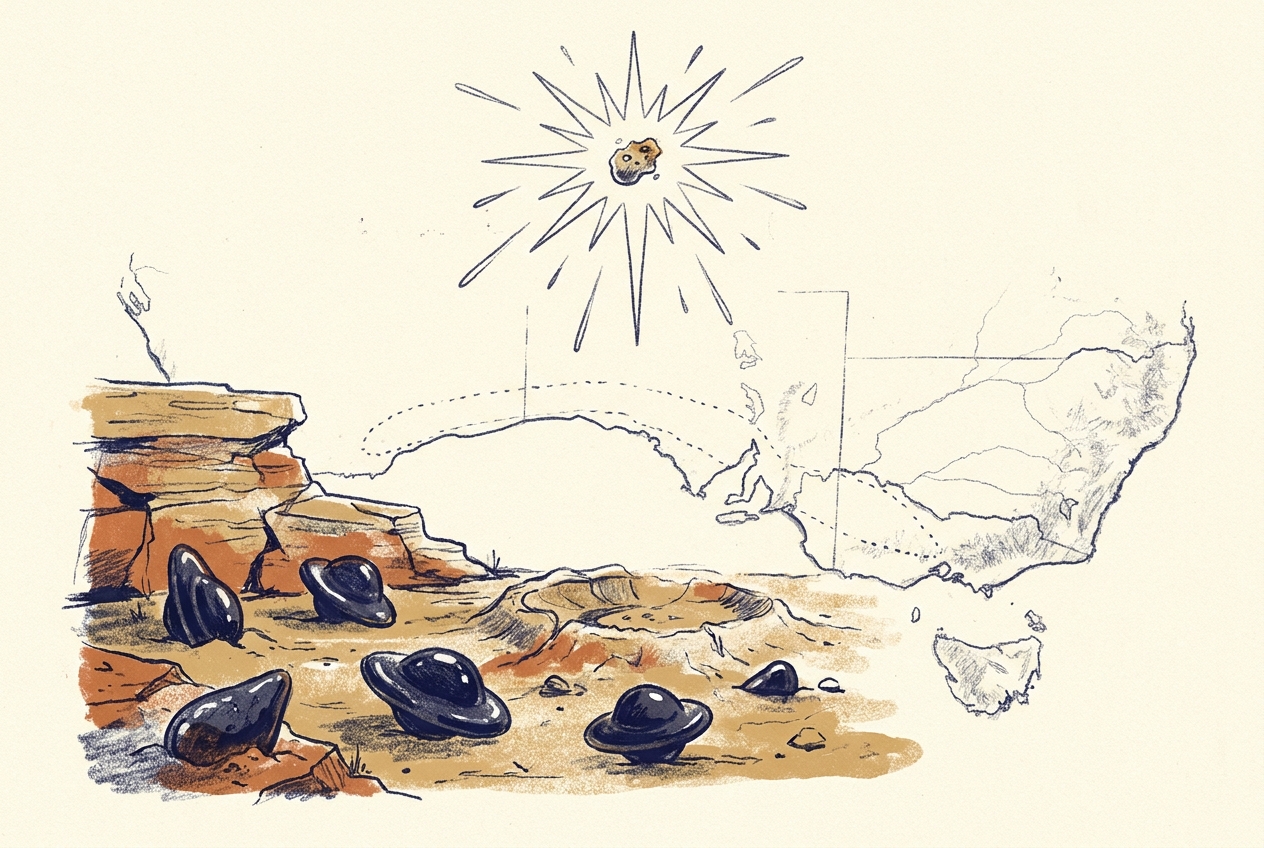
About 790,000 years ago, something fell from the sky over Southeast Asia and splashed dark glass across a tenth of the Earth's surface. In Australia, that glass landed as tektites—black, aerodynamically shaped beads strewn from Tasmania to the Nullarbor Plain. They are among the youngest tektites on Earth, and Australia has the best of them.
The Impact That Made Them
The source of the glass lies under Laos and Thailand. The Australasian tektite strewnfield—the largest and youngest on the planet—originated from an impact crater somewhere in Indochina. No one has found the crater itself; it may lie buried beneath young sediments in the Mekong basin or hidden under the Bolaven Plateau's volcanic rocks.
What is certain is the violence. A meteorite perhaps two kilometres wide struck the Earth at hypersonic speed. The impact melted surface rock and flung molten droplets halfway around the planet. Those droplets cooled and solidified in flight, acquiring the aerodynamic shapes—buttons, dumbbells, teardrops—that tektites are known for.
In Australia, the glass fell across an area stretching from the southwest coast to Tasmania and east to New South Wales. The densest concentration lies in the Nullarbor Plain, where the flat, stable limestone surface has preserved tektites with minimal disturbance for nearly a million years.
What the Glass Reveals
Tektites are not meteorites. They are terrestrial rock that was melted, thrown into the upper atmosphere, and quenched into glass before falling back to Earth. Their chemistry matches local sediments at the impact site, not extraterrestrial material.
The Nullarbor tektites are so well preserved that their original surfaces still show the flow ridges and ablation scars from their fiery passage.
Australian tektites are black and opaque, unlike the green moldavites from Europe's Ries crater. They range from a few millimetres to several centimetres across, with the largest specimens weighing about 50 grams. Their internal structure—flow bands, bubbles, and lechatelierite (silica glass) inclusions—records the extreme temperatures and rapid cooling of their formation.
The glass has been dated precisely to 790,000 ± 5,000 years using argon-argon methods. This makes the Australasian impact event the most recent major impact on Earth, and the only one known to have distributed tektites across an entire continent.
Where to Find Them
The Nullarbor Plain is the world's best tektite hunting ground. The region's aridity and lack of soil movement mean that tektites lie exposed on the surface, often alongside ancient Aboriginal stone tools. Aboriginal people collected tektites and used them as sacred objects, trade items, and even cutting tools.
In the Flinders Ranges, tektites occur in younger alluvial deposits. Along the Murray River in South Australia, they have been found in Pleistocene river gravels. Tasmania has yielded a few specimens from the central highlands.
Collectors and scientists distinguish several types: australites (the classic Australian button form), Muong Nong-type tektites (larger, layered blocks found in Laos), and microtektites (sub-millimetre glass spheres found in deep-sea sediments). The button-shaped australites are the most distinctive, with a central disc and a raised flange formed by ablation during re-entry.
A Window Into Catastrophe
The Australasian impact event may have affected human evolution. At 790,000 years ago, the event coincides with a shift in the Earth's magnetic field and a period of climatic change. Some researchers have suggested that the impact caused a temporary cooling event, though the evidence is debated.
What is not debated is the sheer scale of the event. The strewnfield covers at least 50 million square kilometres—roughly ten percent of the Earth's surface. The amount of melted rock ejected was on the order of a billion tonnes. Yet the source crater remains missing.
Australian tektites continue to yield new information. Recent studies of their geochemistry have traced the impact to a sedimentary target rock rich in loess. Others have found evidence of a double impact or a fragmented meteoroid. The glass beads that fell on ancient Australia are still teaching us about the violence that shaped our planet.
More like this
- The 110-Million-Year-Old River That Runs Backwards UndergroundWestern Australia's 110-million-year-old dune system has been slowly dissolving into a labyrinth of caves where an ancient river still flows, carrying the taste of a Cretaceous desert.
- The 5-Million-Year-Old Cave Archive Beneath a Treeless PlainBeneath the treeless Nullarbor Plain, a labyrinth of limestone caves preserves five million years of Australian climate in sediment layers, fossil bones, and ancient air bubbles.
- The 790,000-Year-Old Scar That Still Holds ShrapnelOn the Nullarbor Plain, a 790,000-year-old meteorite left a 24-metre-wide crater that preserves fragments of the iron projectile itself—a rare survival among Earth's impact structures.