18 May 2026 · 3 min read
The Lake That Breathed Iron: Western Australia's Hamersley Banded Iron Formations
How 2.5-billion-year-old iron-rich layers in Western Australia's Hamersley Range record Earth's first great oxygenation event, laid down by ancient microbes in a sea without life.
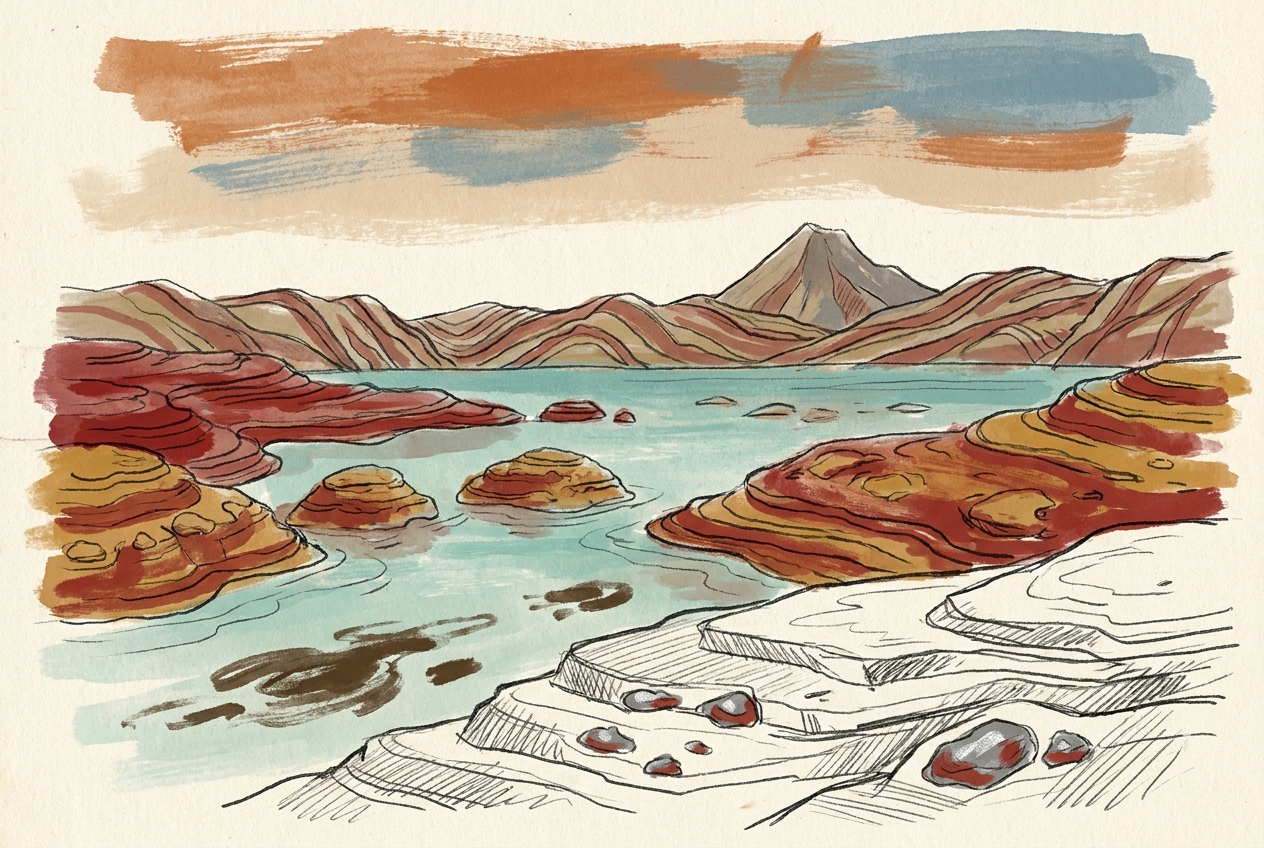
Somewhere in the Pilbara, a slab of rock two and a half billion years old holds more iron than a thousand modern ships. It weighs nothing special in the hand—dense, yes, rust-coloured, banded like a tree stump in red and grey—but it represents a chemical accident that never happened before and has never happened since. The Hamersley banded iron formations are the largest iron deposits on Earth, and they are a fossil of the planet's first atmosphere.
The Microbes That Changed the Sky
Before 2.5 billion years ago, the oceans were rich in dissolved iron. Not a trace element, but a fog of ferrous iron that stained the ancient seawater like rust in a flooded mine. There was no free oxygen in the atmosphere to react with it. The iron simply stayed dissolved, waiting.
What finally triggered the reaction was life. Cyanobacteria in the shallow seas of the Pilbara had learned to split water molecules using sunlight, releasing oxygen as a waste product. That oxygen, once it escaped the microbial mats, immediately bonded with the dissolved iron. The reaction produced insoluble iron oxide, which settled to the seafloor in fine particles. Layer by layer, over tens of millions of years, the iron precipitated out of solution and accumulated into beds hundreds of metres thick.
The Hamersley Range preserves this slow, vast chemistry experiment. The red bands are iron oxide; the grey bands are silica-rich chert. Each pair represents a seasonal or orbital cycle—perhaps something as simple as a bloom of cyanobacteria in summer and a quiet winter settling. The rock is a calendar written in rust.
The iron in the Hamersley formations amounts to roughly 90 billion tonnes of metal—enough to build a skyscraper for every person on the planet.
A Sea Without Scavengers
The reason these deposits are so pure is that nothing was there to disturb them. No burrowing organisms churned the seafloor. No fish grazed the microbial mats. The Hamersley sea was sterile by modern standards—no animals, no plants, only bacteria and archaea. The sediment settled in perfect, unmixed layers and stayed that way for hundreds of millions of years.
That stillness ended when the free oxygen finally overwhelmed the dissolved iron. Once all the iron had precipitated, oxygen began accumulating in the atmosphere for the first time. The Great Oxidation Event, roughly 2.4 billion years ago, was the result of the same cyanobacteria that built the Hamersley formations. The banded iron formations mark the end of the Archaean and the beginning of the Proterozoic—a quiet, iron-written boundary between two chapters of Earth history.
The Landscape That Dug Itself
The Hamersley Range today is not a mountain belt in the ordinary sense. It is a dissected plateau, a flat-lying stack of sedimentary rocks that rivers have carved into mesas, gorges, and steep-sided ridges. The iron-rich layers are so resistant to erosion that they form the caprock of the range, protecting the softer shales and dolomites beneath. Where the iron has been mined, the landscape looks like a staircase whose treads are rust-red and whose risers are pale grey.
Mining began in earnest in the 1960s, when the Broken Hill Proprietary Company opened operations at Mount Tom Price. The iron ore here is not the original banded formation but a enriched version—leached and concentrated by groundwater over 2 billion years, raising the iron content from 30 percent to over 60 percent. The modern mines are open pits that descend through the same layers the cyanobacteria built, extracting the oxygen that once poisoned the Archaean world and feeding it into blast furnaces that will eventually return it to the atmosphere.
The Silence of Deep Time
Walking across a freshly exposed surface of banded iron formation, the first thing you notice is the regularity of the bands. They are not chaotic. They are rhythmic, like tree rings or varves, each one a few millimetres to a few centimetres thick. You can count them, though you will not reach the end. The entire formation is roughly 2,500 metres thick, and each metre contains hundreds of bands. The time represented is almost unimaginable.
And yet the rock itself is ordinary. It rings under a hammer, breaks with a sharp conchoidal fracture, and leaves red dust on your fingers. The same dust that once filled the Archaean oceans now stains the hands of geologists and the hulls of bulk carriers leaving Port Hedland. The iron in every car, every bridge, every steel beam on the continent began here, in a sea without animals, precipitated by microbes that had never seen a predator.
More like this
- The 560-Million-Year-Old Garden That Never Saw a PredatorIn South Australia's Flinders Ranges, 560-million-year-old Ediacara surfaces preserve entire seafloor communities of fronds, discs, and quilts — a garden of soft-bodied life that flourished before pre
- The 1.75-Billion-Year-Old Reef That Outranks the BarrierA 1.75-billion-year-old microbial reef in the Kimberley is the largest biological structure ever built by a single species, preserving a world without predators.
- The 1.85-Billion-Year-Old Caldera That Still Feeds the FurnaceIn South Australia's Middleback Ranges, a 1.85-billion-year-old volcanic caldera collapsed and later became one of the world's richest iron ore deposits.