12 July 2026 · 4 min read
The 1.2-Billion-Year-Old Seabed That Still Holds a Frozen Tsunami
In the Kimberley's Bungle Bungle Range, a 1.2-billion-year-old turbidite bed preserves the exact moment a submarine avalanche swept across an ancient seafloor, now frozen in sandstone.
In the Bungle Bungle Range of Western Australia, a single slab of sandstone holds the record of a tsunami that moved at eighty kilometres per hour across the floor of a Proterozoic sea. The wave never broke the surface. It travelled in darkness, a slurry of sand and water, and then it stopped. The rock still preserves the moment of impact.
The Bed That Should Not Be There
The Bungle Bungle massif — known formally as Purnululu National Park — is built from 1.2-billion-year-old quartz sandstone of the Devonian Reef Group. The range's famous beehive domes are carved by weathering along joint planes, but the rock itself is a monument to deposition, not erosion. The sand grains that form each dome were laid down in a shallow marine basin that once covered much of northern Australia.
Most of the Bungle Bungle sequence accumulated slowly, grain by grain, under quiet water. But one bed tells a different story.
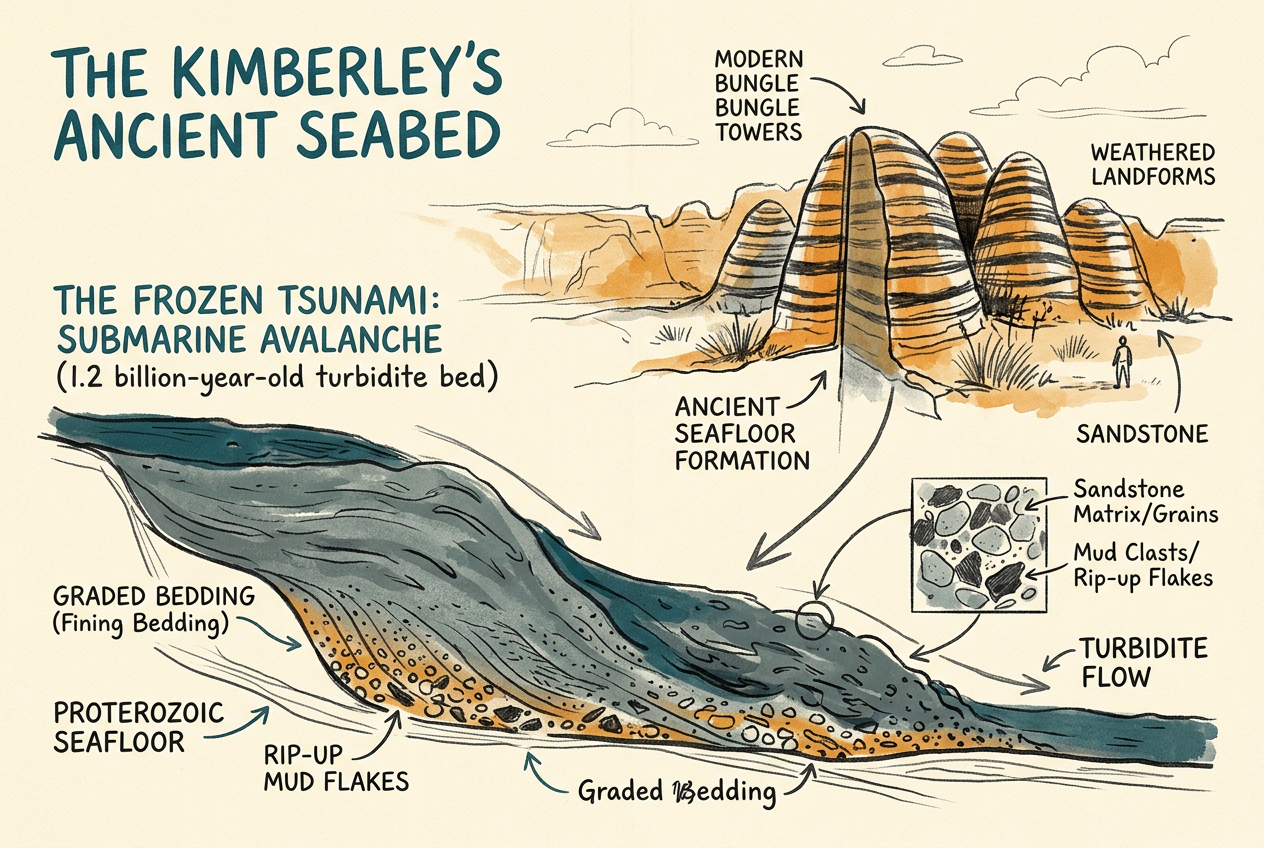
Scattered through the massif are individual layers where the sandstone grades abruptly from coarse pebbly grit at the base to fine silt at the top. Geologists call this a graded bed. It forms when a single pulse of sediment falls out of suspension as the current that carried it loses energy. The coarsest material settles first; the finest, last. These beds are the signature of a turbidity current — an underwater avalanche.
The 1.2-Billion-Year-Old Avalanche
A turbidity current begins when sediment piled on a continental slope becomes unstable. A slump, an earthquake, or simply the weight of accumulating sand triggers a collapse. The sediment mixes with water and becomes a dense slurry that flows downhill under gravity, moving faster than any river on land.
In the Proterozoic basin that became the Bungle Bungle, such an event released a mass of sand and mud from the shelf edge. The slurry accelerated down the slope, entraining more sediment and water as it moved. By the time it reached the basin floor, it was travelling at speeds estimated between sixty and a hundred kilometres per hour — a submarine avalanche that could have swept away anything in its path.
The wave travelled in darkness, a slurry of sand and water, and then it stopped. The rock still preserves the moment of impact.
When the current hit the flat basin floor, it slowed abruptly. The sediment fell out of suspension in a single graded layer, often no more than a metre thick. That layer is now exposed in cliff faces throughout the Bungle Bungle — a frozen tsunami, visible as a single band of rock that runs through the beehive domes.
What the Bed Reveals
The turbidite bed tells geologists several things about the Proterozoic world. First, the basin was deep enough for a turbidity current to develop and travel unimpeded — likely several hundred metres of water. Second, the continental slope was steep enough for sediment to accumulate and fail, implying an active margin or a rift basin.
Third, the bed is not alone. Multiple turbidite layers occur in the Bungle Bungle sequence, suggesting that these submarine avalanches were a recurring feature of the basin for millions of years. Each event reset the seafloor, burying whatever had accumulated since the last pulse. The result is a rhythm of catastrophe: long periods of quiet deposition punctuated by moments of violent emplacement.
The graded beds also preserve a chemical signature. The sand grains in the coarse basal layer are angular, indicating they were not transported far before the avalanche. The fine silt at the top contains clay minerals that settled in the days or weeks after the main event. Between them lies the entire history of a single geological instant.
The Landscape That Weathering Made
The Bungle Bungle domes exist because the turbidite beds are more resistant to erosion than the surrounding sandstone. The graded layers contain a higher proportion of quartz cement, deposited as silica-rich fluids moved through the coarser pore spaces. This cement armoured the beds against the chemical weathering that hollowed out the softer rock around them.
The result is a landscape where the beehive domes are striped by horizontal bands — the turbidite beds running like contour lines across the domes. From a distance, the bands look like tiger stripes. Up close, they are the preserved edges of ancient avalanches, each one a record of a seafloor catastrophe that lasted no longer than a single day.
The Bungle Bungle turbidites are not unique in the geological record, but they are among the best exposed on Earth. In most places, graded beds are visible only in road cuts or drill cores. Here, they form the defining feature of a World Heritage landscape — a reminder that the quietest places on Earth were built by violent events that ended in stillness.
More like this
- The 4.5-Million-Year-Old Volcanoes That Never Saw the SkyAustralia's flat-topped tuyas preserve the rare record of volcanoes that erupted beneath Pliocene glaciers, their basalt caps now standing as the oldest known examples of ice-confined eruptions on Ear
- The 1.6-Billion-Year-Old Sill That Cooked the Red CentreIn Central Australia, 1.6-billion-year-old Stuart Pass diabase sills intruded ancient sediments and cooked them into quartzite, creating the rocky spine of the MacDonnell Ranges.
- The 1.6-Billion-Year-Old Pillows That Still Rest on the SeafloorIn the McArthur Basin, 1.6-billion-year-old pillow basalts preserve the shape and chemistry of lava that erupted into a Proterozoic sea, recording the oxygen-poor ocean where the pillows still rest.